

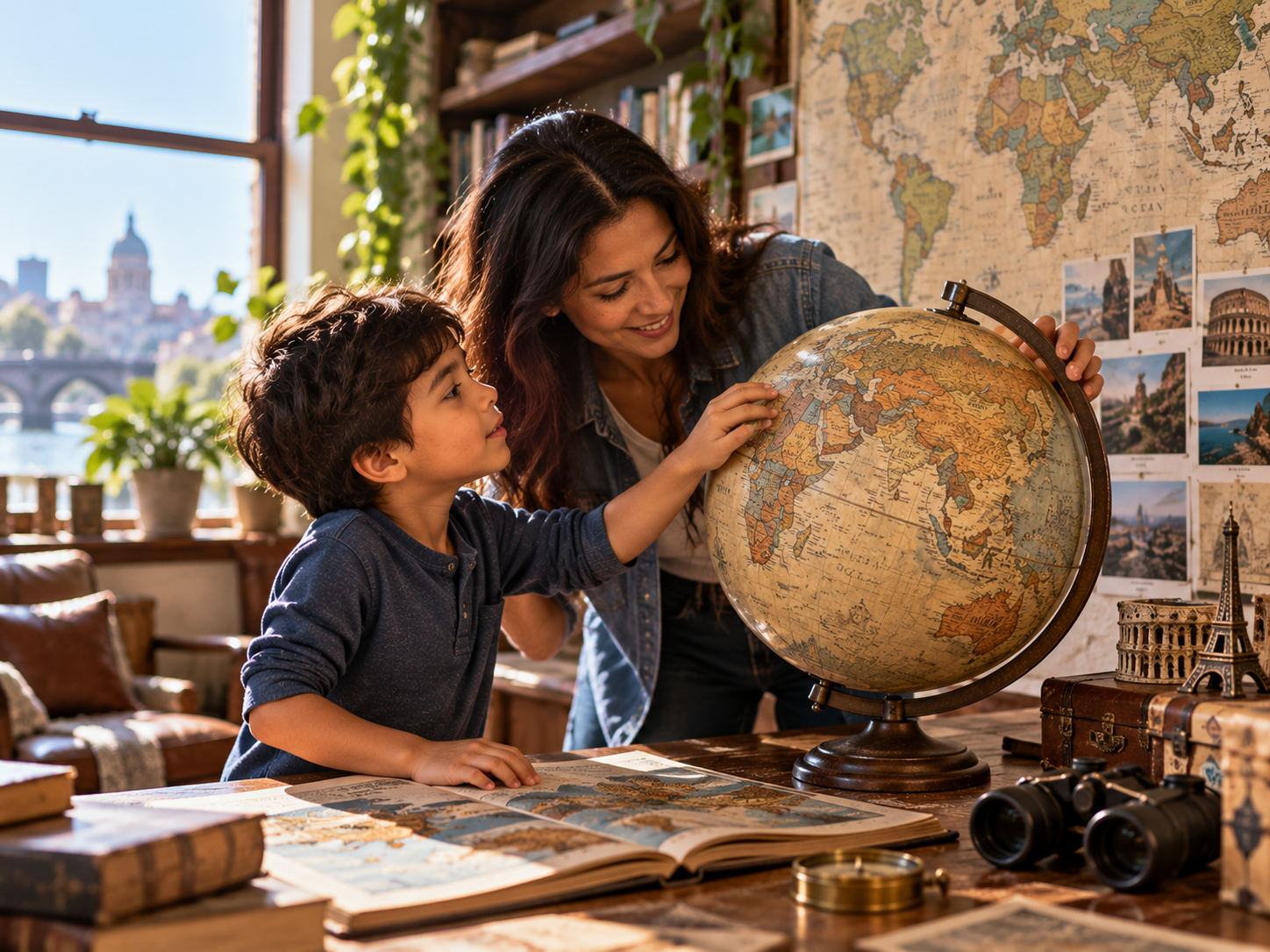
Start with the place around you
Geography does not have to begin with a map of the world.
Start with somewhere your child knows. Where is your home? What is nearby? Is the area flat or hilly? Is there a park, a river, a beach, a busy road, or a train station? What changes when you travel to another part of town?
From there, the world can gradually become larger. A neighborhood sits inside a city. A city is part of a region and a country. Countries are part of continents, and continents are part of a planet with oceans, climates, mountains, deserts, forests, and countless other landscapes.
That growing sense of scale is one of the most natural ways to introduce geography.
What makes one place different from another?
Put two places side by side and there will usually be a reason they are different.
A town beside a river may have developed around water and transportation. A community in a very cold region has to build, travel, and work in ways that fit its climate. A city on a coast may depend on its harbor. A farming region depends partly on its soil, water, and climate.
These connections are where geography becomes interesting. Children can begin asking not only where is this? but why is it here?
They can explore mountains and valleys, rivers and oceans, forests and deserts, weather and climate, cities and farms. They can look at how plants and animals fit into different environments and how people adapt to the places where they live.
Maps are a way of seeing the world
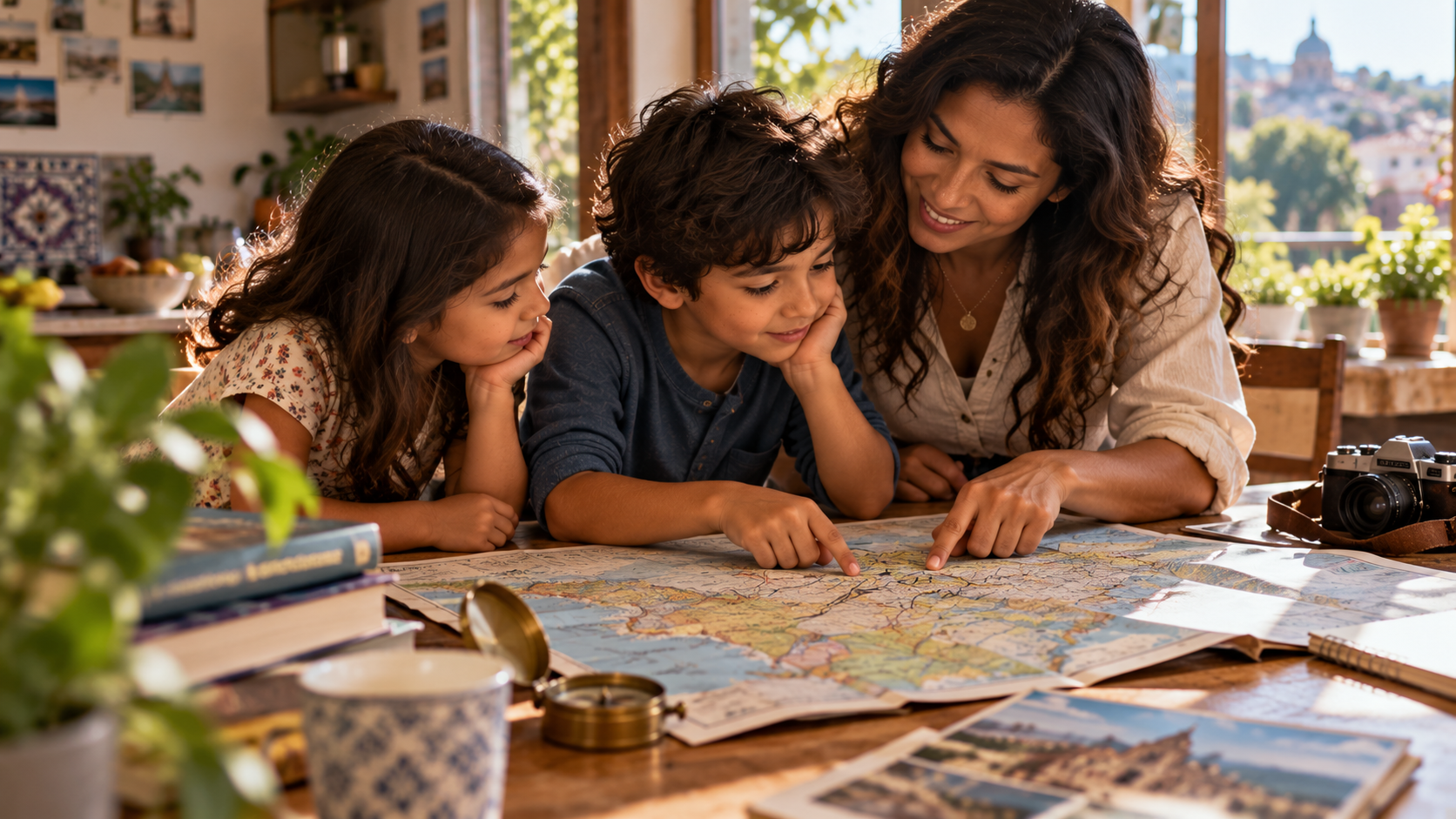
A map is more than a collection of names to memorize. It is a way of representing something that is too large to see all at once.
A road map shows routes. A weather map shows patterns in the atmosphere. A political map shows borders. A physical map can show mountains, rivers, and other features of the landscape.
Learning to use maps therefore involves more than finding a country. Children gradually learn to understand symbols, direction, distance, scale, and relationships between places. Research on map learning shows that these skills develop over time, and that children benefit from working with different kinds of maps and real-world environments.
You can begin very simply. Look at a map of your neighborhood and find your home. Trace a route to school. Find the place where a relative lives. Look at a map before a trip and then compare it with what you actually see.
The National Academies describes spatial thinking as a combination of understanding space, representing it with tools such as maps, and reasoning about those representations. That makes geography useful well beyond geography itself.
Explore places, not just countries
Countries are an important part of geography, but a place is much more than its name and capital.
A child exploring Japan might wonder why so many people live in cities, why earthquakes matter there, how mountains and coastlines shape the country, or why certain foods are common.
A child exploring the Sahara might start with a desert and end up asking about rainfall, animals, trade routes, settlements, and how people travel across such a large region.
A child exploring New York City might notice the harbor, the bridges, the subway, the density of buildings, and the many different communities that make up the city.
A good geographical question can turn a place into a doorway to many other areas of knowledge.
People shape places, and places shape people
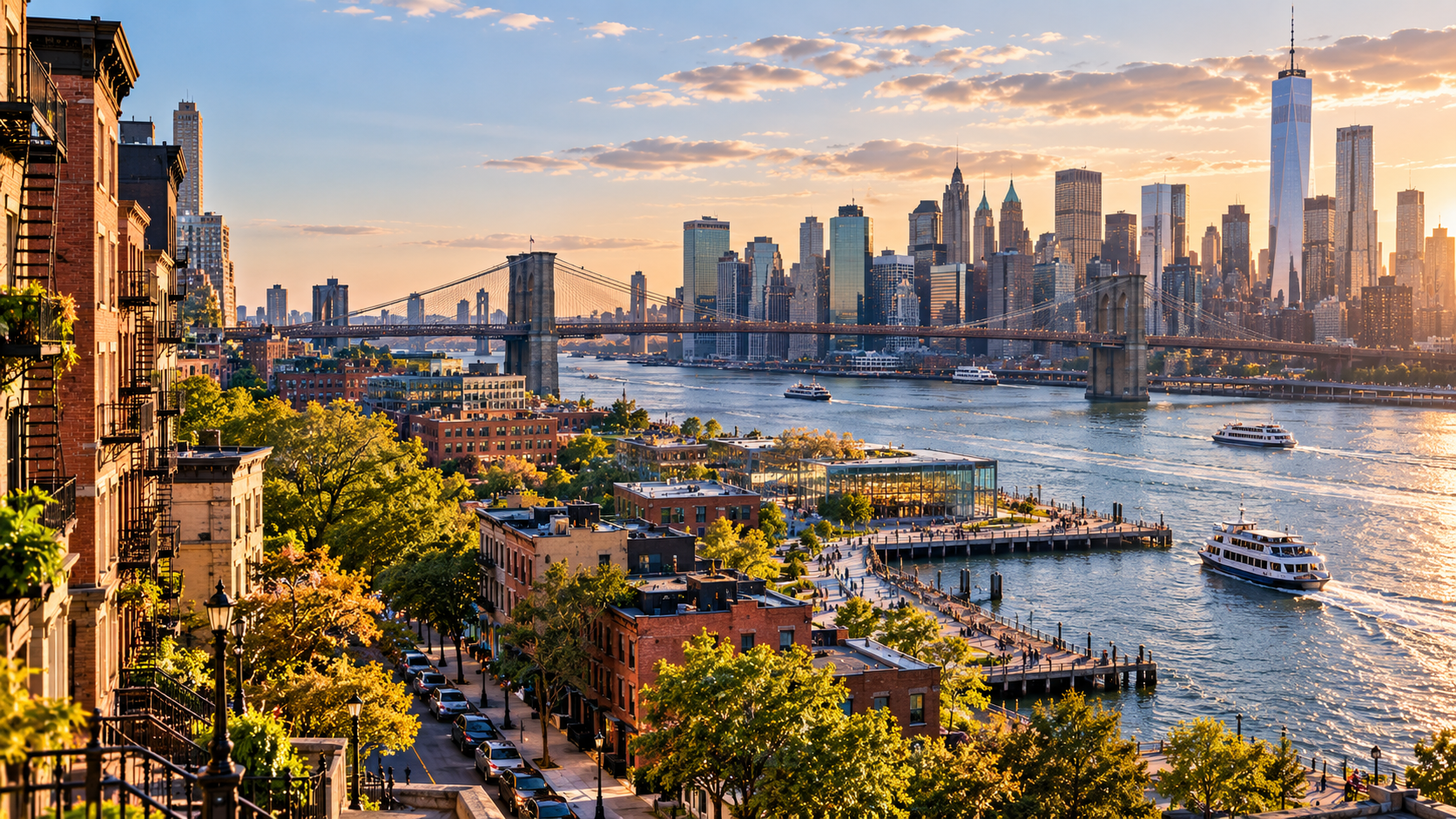
Geography is partly about the natural world, but it is also about people.
Humans build roads, cities, ports, farms, dams, bridges, and airports. We change rivers, clear forests, move goods across oceans, and create enormous urban areas. At the same time, the landscape, climate, available resources, and location of a place influence what people can do there.
This creates interesting questions for children. Why was this city built here? Why do so many people live along this river? Why are some places densely populated while others are not? Why are certain goods produced in particular parts of the world?
These questions can lead naturally into history, technology, economics, environmental science, and culture.
Geography is all around you
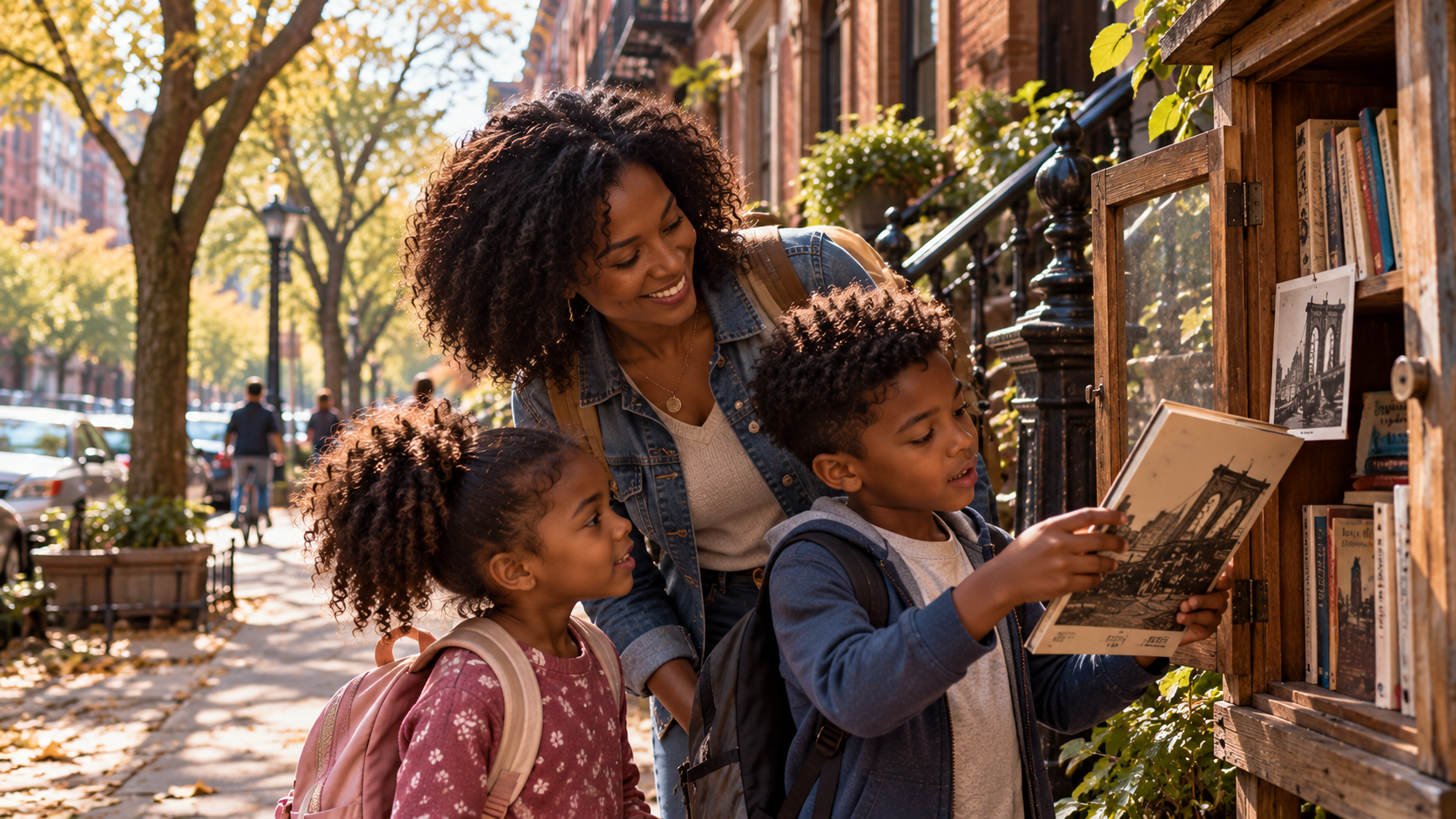
You do not need a special geography lesson to explore places.
A weather forecast can lead to a conversation about climate. A grocery store can raise the question of where food comes from. A train journey can turn into a map exercise. A flight can become a chance to look at the route and see what lies below it.
Even a walk around the neighborhood can reveal geography. Notice which streets are busy and which are quiet. Look at where buildings are concentrated. Find the highest point nearby. Follow a stream or drainage channel. Ask why a road follows one particular path.
These small observations help children connect maps and geographical ideas to the real world.
Geography connects to almost everything
A question about a place rarely stays inside geography for long.
Why did an ancient civilization grow beside a river?
Why is one region covered in rainforest?
Why do cities have roads, bridges, and subway systems?
Why do people speak different languages in neighboring regions?
Why do countries trade with one another?
Geography provides a useful framework for making these connections because every subject happens somewhere.
What can children explore in geography?
There is no single correct sequence. A child who loves animals might begin with habitats. Another might become fascinated by maps, flags, mountains, cities, or unusual places around the world.
Some natural areas of exploration include:
Maps, directions, and navigation
Learn how maps represent places, routes, distance, and direction.
Continents, countries, and regions
See how the world is divided and how places relate to one another.
Cities and settlements
Explore why communities grow where they do and how they are organized.
Mountains, rivers, lakes, and oceans
Discover the physical features that shape landscapes and lives.
Weather, climate, and landscapes
Look at the patterns that make places hot, cold, wet, dry, flat, or mountainous.
Habitats and ecosystems
Connect living things to the environments where they survive.
People, cultures, and communities
Explore the many ways people live, communicate, and build communities.
Borders and territories
Understand how places are divided, governed, and represented.
Transportation and trade
Follow how people and goods move between places.
How people change the environment
Notice how roads, farms, cities, dams, and other choices reshape places.
How places change over time
See how natural processes and human activity transform a place.
The important part is what comes after the first fact. Knowing that the Amazon is a huge rainforest is interesting. Asking why such a rainforest exists there opens a much richer path.
Geography can grow with your child
The same place can support very different questions at different ages.
A young child might simply want to find Africa on a map. Later, that same child might wonder why Africa has such different climates, why major cities developed where they did, or how geography influenced trade and migration.
There is no need to wait until a child can understand every detail. Geography works particularly well when the questions grow along with the child's ability to reason about distance, patterns, cause and effect, and different perspectives.
You don't need to be a geography expert
You probably won't remember every capital, mountain range, or river. That's fine.
You can explore a map together, look something up, and follow the question wherever it leads. In fact, not knowing the answer can be useful. It gives your child a reason to investigate rather than simply waiting for an adult to provide the answer.
The goal is not to turn every trip to the supermarket into a geography lesson. It is to help your child notice that places have stories, patterns, and relationships worth understanding.
How Sapienta fits in
There is an enormous amount of geography a child could explore. The harder question is deciding what is worth introducing next.
Sapienta helps parents discover ideas that fit their child's interests, age, and growing knowledge. A child who has been exploring animals might get a recommendation about habitats. A child fascinated by cities might move into maps, transportation, architecture, or how cities develop.
The aim is to build knowledge over time, with enough variety to keep curiosity alive and enough depth for individual interests to develop.