
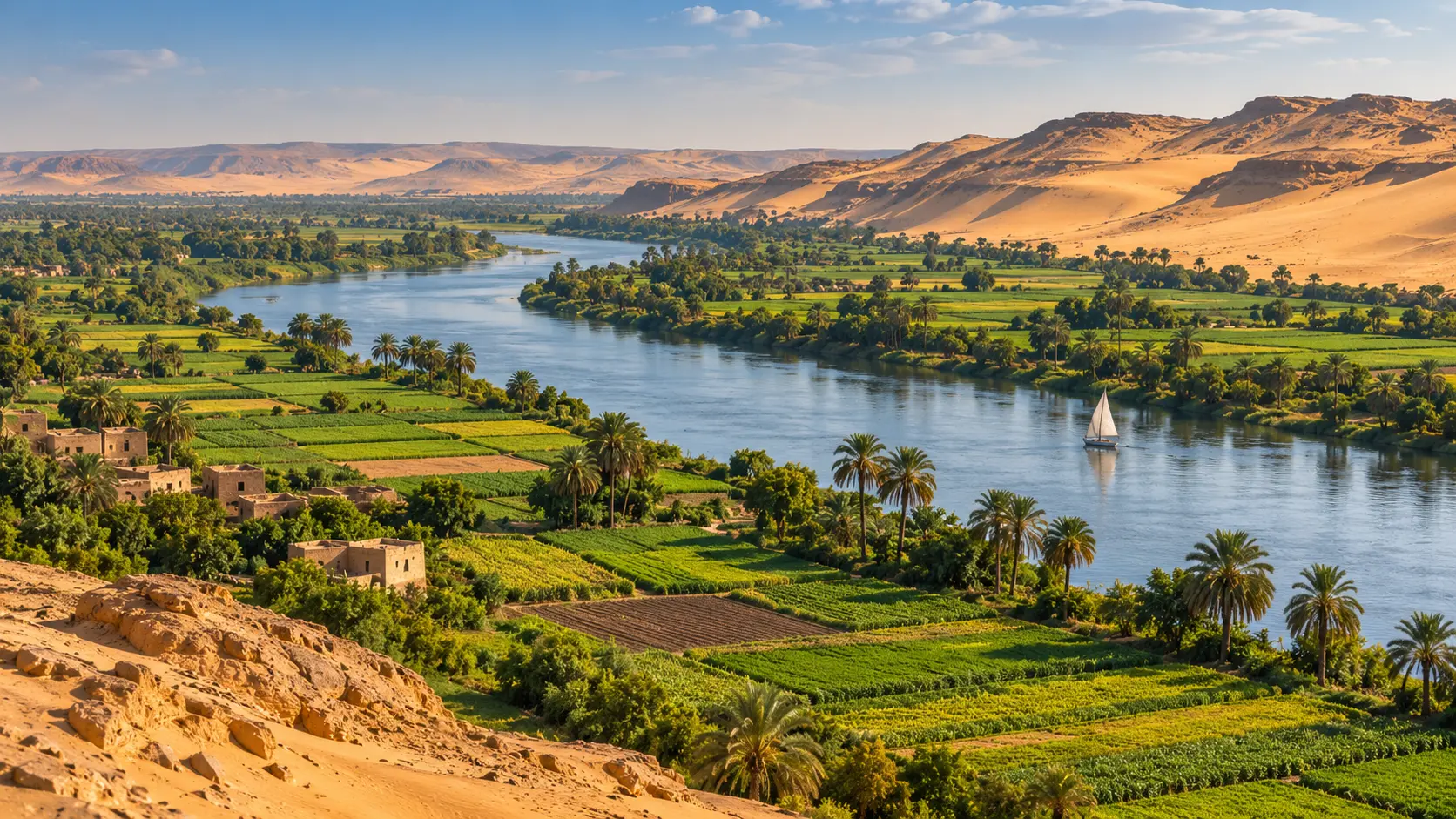
Rivers provided the ingredients for settlement
Many early civilizations developed near large rivers. This was no coincidence.
A river provided fresh water for people and animals, helped farmers grow crops, and offered a way to travel and transport goods. In some regions, seasonal floods also carried fertile soil from upstream and deposited it along the riverbanks, making the surrounding land particularly good for farming.
Consider the Nile River in ancient Egypt. Much of the surrounding land was desert, but the Nile created a long, narrow strip of fertile land where people could grow food. Without the river, supporting large populations in that environment would have been much more difficult.
A similar situation existed in Mesopotamia, the region between the Tigris and Euphrates rivers, in what is now Iraq. The rivers provided water and fertile land, allowing farming communities to grow into increasingly large settlements.
The rivers weren't always easy to live beside. Floods could be unpredictable, and farmers sometimes had to work together to build canals and other systems to bring water to their fields. But the benefits were enormous, particularly when communities learned how to manage the water.
Farming changed the size of communities
Before farming became widespread, many human communities survived by hunting animals, fishing, and gathering wild plants. People often moved from place to place as food sources changed.
Agriculture gradually changed this way of life. Once people learned to grow crops and raise animals, they could produce food in a more predictable way and settle in one place for longer periods.
Farming also made it possible to produce more food than a family needed immediately. This extra food is called a surplus.
Why was that so important?
Imagine a village where every person has to spend the entire day finding or growing food. There isn't much time left to build houses, make tools, create pottery, develop new technologies, or organize trade.
But if farmers can produce enough food to feed more people than those working in the fields, some members of the community can take on other jobs. One person might become a potter, another a builder, another a metalworker, and someone else might organize trade or manage the community.
Over time, this division of work helped settlements become larger and more complex. Markets, workshops, religious centers, and systems of government developed, creating many of the features we associate with civilizations today.
The growth of early cities was therefore closely connected to the ability to produce and distribute food. OpenStax explains how agricultural surpluses supported population growth, specialized work, and the development of early urban societies.
Not all civilizations developed in the same place
Some of the earliest major civilizations emerged in different parts of the world, often near important rivers.
In Mesopotamia, cities such as Uruk developed between the Tigris and Euphrates rivers. In Egypt, settlements grew along the Nile. Farther east, the Indus Valley civilization developed around the Indus River, in parts of modern-day Pakistan and India.
In China, early agricultural communities developed around the Yellow River and the Yangtze River, where people cultivated different crops suited to their environments.
These societies were separated by enormous distances and developed their own languages, traditions, technologies, and systems of government. They didn't all grow in exactly the same way, even though their environments shared some useful features.
And rivers weren't the only places where complex societies developed. In Central America, the Maya built cities in regions with very different landscapes and water conditions. In the Andes Mountains of South America, civilizations developed at high elevations, where people learned to farm on steep slopes and adapt to challenging environments.
This is an important distinction: rivers provided major advantages in many regions, but people found different ways to build successful societies in other environments too. National Geographic's overview of early agricultural communities describes how farming developed independently in several parts of the world.
Geography also influenced trade
A civilization needed more than food to grow. It also needed materials, tools, and connections with other communities.
Some regions had plenty of fertile land but lacked important resources such as metal ores, good building stone, or particular types of wood. Other places had valuable materials but couldn't grow enough food to support large populations.
Trade helped solve this problem.
Rivers made it easier to move heavy goods, while coastlines and natural harbors provided opportunities for travel by sea. Mountain passes and land routes connected communities that were otherwise separated by difficult terrain.
Mesopotamian cities, for example, traded with distant regions to obtain materials they didn't have locally. Merchants moved goods such as timber, metals, and precious stones, while also carrying ideas, technologies, and cultural practices.
A settlement located along an important trade route could become wealthy and influential even if its surrounding farmland was limited.
Geography could therefore make a place valuable for reasons beyond agriculture.
Natural features could offer protection
Where people settled also affected how easily they could defend themselves.
Mountains, deserts, rivers, and seas sometimes acted as natural barriers, making it harder for enemies to reach a settlement. A city surrounded by difficult terrain might be easier to protect than one located on a wide, open plain.
But these same features could also create problems. Mountains made travel and farming difficult, while deserts could limit access to water. A river that helped farmers grow food could also provide a route for invading armies.
People had to find ways to use their surroundings to their advantage while dealing with the disadvantages.
This helps explain why geography influenced not only where civilizations developed, but also how they built their cities, organized their armies, traded with neighbors, and protected their resources.
People learned to change their environment
One of the most remarkable things about early civilizations is how much people learned to accomplish with the resources available to them.
They built irrigation canals to bring water to distant fields, constructed dams and reservoirs, created roads through difficult landscapes, and developed ways to store food for times when harvests were poor.
In places where rivers flooded unpredictably, communities had to organize workers to manage water and repair irrigation systems. In mountainous regions, people developed terraces, which are flat farming areas built into hillsides. These allowed them to grow crops on land that would otherwise have been difficult to cultivate.
The environment influenced what was possible, but human ingenuity made many more things possible than nature had provided on its own.
A good example is ancient Egypt. The Nile provided the water and fertile land that supported its population, but Egyptians also developed sophisticated farming practices, building techniques, writing, mathematics, and systems of administration.
The river created an opportunity. People built a civilization around it.
Why didn't every good farming region become a great civilization?
Having fertile land and plenty of water didn't guarantee that a large civilization would develop.
Communities also needed ways to organize themselves, cooperate, exchange goods, manage resources, and deal with conflicts. Changes in climate, disease, warfare, and political decisions could affect whether a settlement grew or declined.
Sometimes a place that had supported a large population for centuries became less suitable because rivers changed course, rainfall decreased, or important trade routes shifted.
Other settlements remained small even when the surrounding land was productive. There were many factors involved, and historians still investigate why some societies grew into powerful cities while others developed along different paths.
This is why studying ancient civilizations is also a way of understanding geography, climate, technology, economics, and human cooperation. Their stories are closely connected.
Geography still shapes where people live today
Look at a map of the modern world and you'll notice that many major cities are still located near rivers, coastlines, and important transportation routes.
London grew along the Thames, Paris along the Seine, and Shanghai near the mouth of the Yangtze. These locations helped with transportation, trade, access to water, and connections with other regions.
Of course, modern technology has changed what is possible. Cities can now transport water over long distances, build in difficult environments, and connect to the rest of the world through roads, railways, airports, and digital networks.
But the basic advantages of geography haven't disappeared. Water, resources, transport, and access to other communities still matter.
When we look at where ancient civilizations developed, we're also learning something about why human settlements are located where they are today.
Explore it together
Open a world map and look for the locations of some early civilizations: Mesopotamia, ancient Egypt, the Indus Valley, and ancient China.
Find the major rivers that flowed through these regions. Then look at the surrounding geography. Where are the mountains? Where are the deserts? Which areas have access to the sea?
Ask your child to imagine building a new settlement in one of these places. Where would they put the homes? Where would they grow food? How would they get water? What would they trade with other communities, and how would they protect the settlement?
There is no single correct answer. The interesting part is discovering how different the possibilities become depending on the landscape.
How Sapienta can help
A question about where ancient civilizations developed can lead to geography, farming, trade, architecture, technology, governments, and the lives of people who built the first cities.
Sapienta helps parents follow those connections. It considers what a child has already explored, along with their age and interests, and helps find another idea that builds naturally from what they already know.
You don't need to plan the entire journey yourself. Start with a question about an ancient city, and let curiosity lead to the next one.
Raise curious, knowledgeable kids.