

How the first cities began
For most of human history, people lived in small groups and moved from place to place to find food. That began to change when people learned to grow crops and raise animals. Farming allowed communities to settle in one place and, in some areas, produce more food than they needed for immediate survival.
That extra food made a big difference. Not everyone had to spend their day growing or gathering food. Some people could become builders, potters, metalworkers, traders, soldiers or religious leaders. They made things, provided services and developed skills that helped their communities grow.
As settlements became larger, people needed places to exchange goods, organize their activities and make decisions. Markets, workshops, public buildings and places of worship appeared, and some settlements grew into cities.
One of the earliest urban centers developed in Mesopotamia, between the Tigris and Euphrates rivers. Cities also grew along the Nile in Egypt, the Indus River in South Asia and the Yellow River in China. These places had different histories, but many benefited from fertile land, reliable water and opportunities to exchange goods with other communities.
You can read more about the emergence of early urban societies in this introduction to the first cities.
Why location matters
A city's location can give it an advantage that lasts for hundreds or even thousands of years.
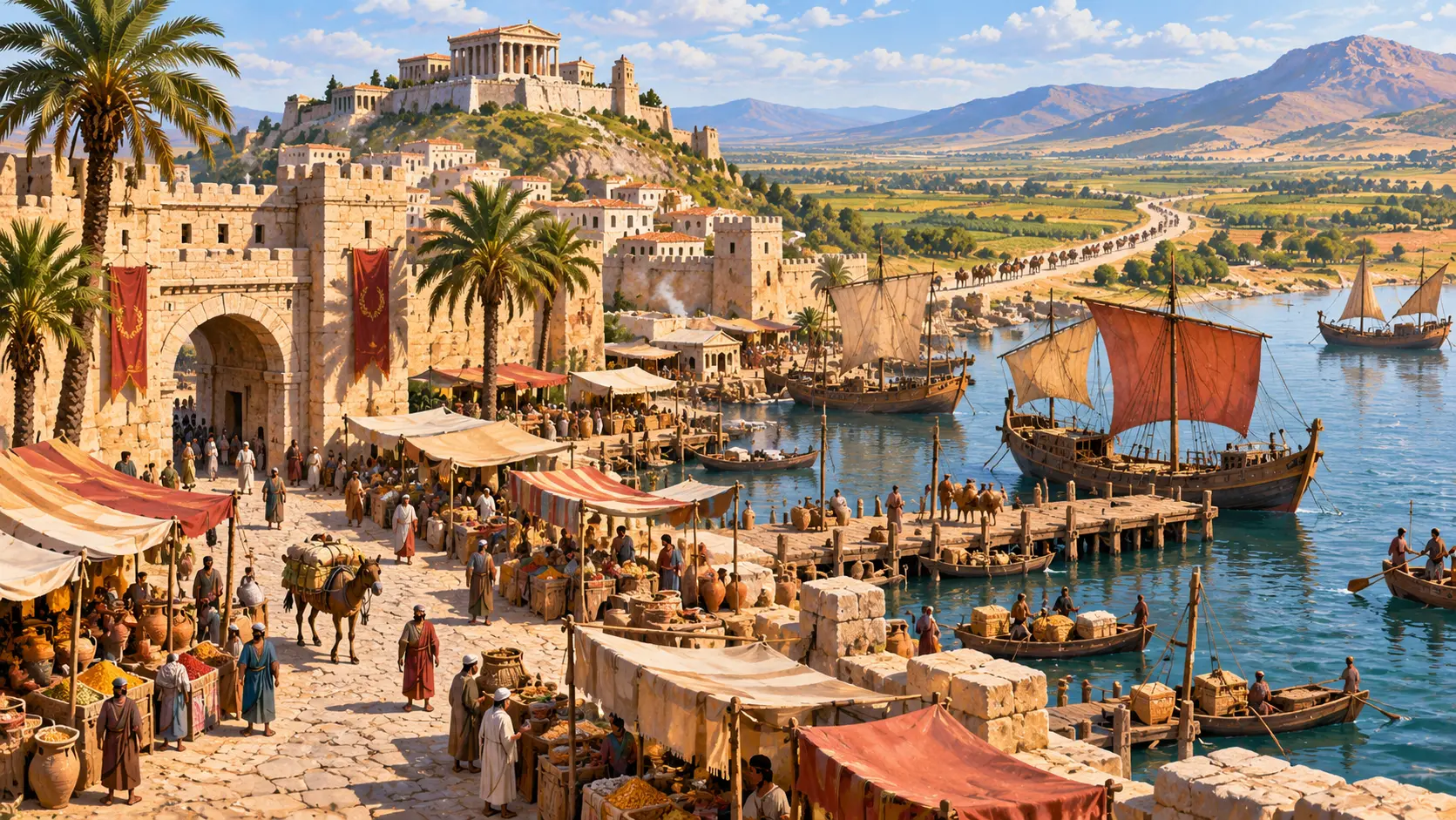
Imagine a settlement beside a river. Farmers nearby can use the water for their crops, while boats can carry food, building materials and other goods to places that would be difficult to reach over land. Traders may stop there to buy and sell things, and some decide to settle permanently. As more people arrive, the settlement grows.
Other cities developed near natural harbors, where ships could load and unload their cargo. Some grew at the meeting point of important roads or trade routes, where merchants from different regions could meet. Others were built on high ground or surrounded by natural barriers, making them easier to defend.
The location did not have to provide everything. A city might have little farmland of its own but become wealthy because it controlled an important harbor or trading route. It could bring in food from the surrounding countryside and exchange it for goods arriving from distant places.
This is one reason cities are often connected to the geography around them. Their importance depends not only on what happens inside the city, but also on how it connects to the places around it.
When trade makes a city famous
Trade can turn a useful settlement into a place known across the world.
Consider Timbuktu, in present-day Mali. It became an important center of trade because of its position near routes crossing the Sahara Desert. Merchants carried goods such as salt and gold across long distances, and Timbuktu became a place where traders, scholars and travelers met.
As trade grew, the city developed other important activities. It became known for its schools and centers of learning, attracting people interested in religion, writing and scholarship. Its influence reached far beyond the people who lived there.
This pattern happened in many parts of the world. Cities grew around markets, ports and trade routes, and their success encouraged even more trade. Merchants brought goods and money, while craftspeople, builders and other workers provided what a growing population needed. A busy city could become a meeting point for people, products and ideas from very different places.
Why governments choose certain cities
Some cities become important because people in power choose to make them centers of government.
When a city becomes the capital of a kingdom or country, it often attracts government officials, soldiers, diplomats, builders and businesses. Important decisions are made there, and public money may be spent on roads, buildings and services.
Rome became the center of a vast empire, and its influence spread across territories far beyond Italy. Much later, Baghdad became the capital of the Abbasid Caliphate and developed into a major center of trade, science and scholarship.
Sometimes a city becomes important because it is already wealthy or well connected. In other cases, rulers deliberately establish a new capital to strengthen their control over a territory or create a new center of power.
Tokyo is an example of a city whose importance grew partly through its political role. When it became the seat of Japan's military government in the early seventeenth century, more people and activities gathered there. It eventually became the country's capital and one of the world's largest cities.
How cities attract more people
Once a city becomes important, it often becomes even more attractive.
A growing city offers more kinds of work. Someone might move there to find a job, learn a trade, study, sell goods or start a business. As more people arrive, they create demand for shops, schools, hospitals, transport and entertainment. These services create more jobs, which attract still more people.
The Industrial Revolution made this process especially visible. Factories needed large numbers of workers, and many people moved from rural areas to cities to find employment. Cities with factories, railways and busy ports expanded rapidly. London, Manchester and other industrial cities grew dramatically during this period.
Today, people still move to cities for many of the same reasons. They may want better access to education, work, healthcare or cultural activities. Large cities also bring together people with different backgrounds and skills, which can encourage new businesses, inventions and ideas.
Can an important city lose its importance?
Yes. A city's success is never guaranteed to last forever.
Trade routes can change, industries can disappear, wars can destroy buildings and infrastructure, and environmental problems can make an area difficult to live in. A city that once attracted merchants and travelers may find that ships now use a different port or that a new road connects businesses somewhere else.
Rome is a good example. It was once the center of a huge empire and one of the largest cities in the world. After the Western Roman Empire collapsed, Rome lost much of its political and economic importance, and its population became far smaller. It remained an important religious and cultural center, but it took many centuries for the city to grow again.
Other cities have experienced similar changes. Some have lost population as jobs moved elsewhere, while others have found new roles as centers of tourism, education, technology or culture.
A city's importance depends on the opportunities it offers and the connections it maintains with the wider world.
Look at the cities around you
You can explore these ideas by looking at a map of your own country. Find its largest cities and its capital. Are they located near the sea, rivers, mountains or major roads? Where are the country's main ports, universities and industrial areas?
Then choose a city with a long history and investigate why it first developed in that location. Was it a trading center, a political capital, a religious destination or something else? Has its role changed over time?
You might discover that a city that seems important today began with a very practical advantage, such as access to water or a good place to cross a river.
Cities bring together many parts of human life, from geography and history to technology, economics and culture. Following the story of one city can lead to questions about the people who built it, the goods they traded, the ideas they developed and the places they connected.
Sapienta helps parents follow these connections and discover what might be interesting to explore next, based on their child's age, interests and previous discoveries.
Raise curious, knowledgeable kids.