
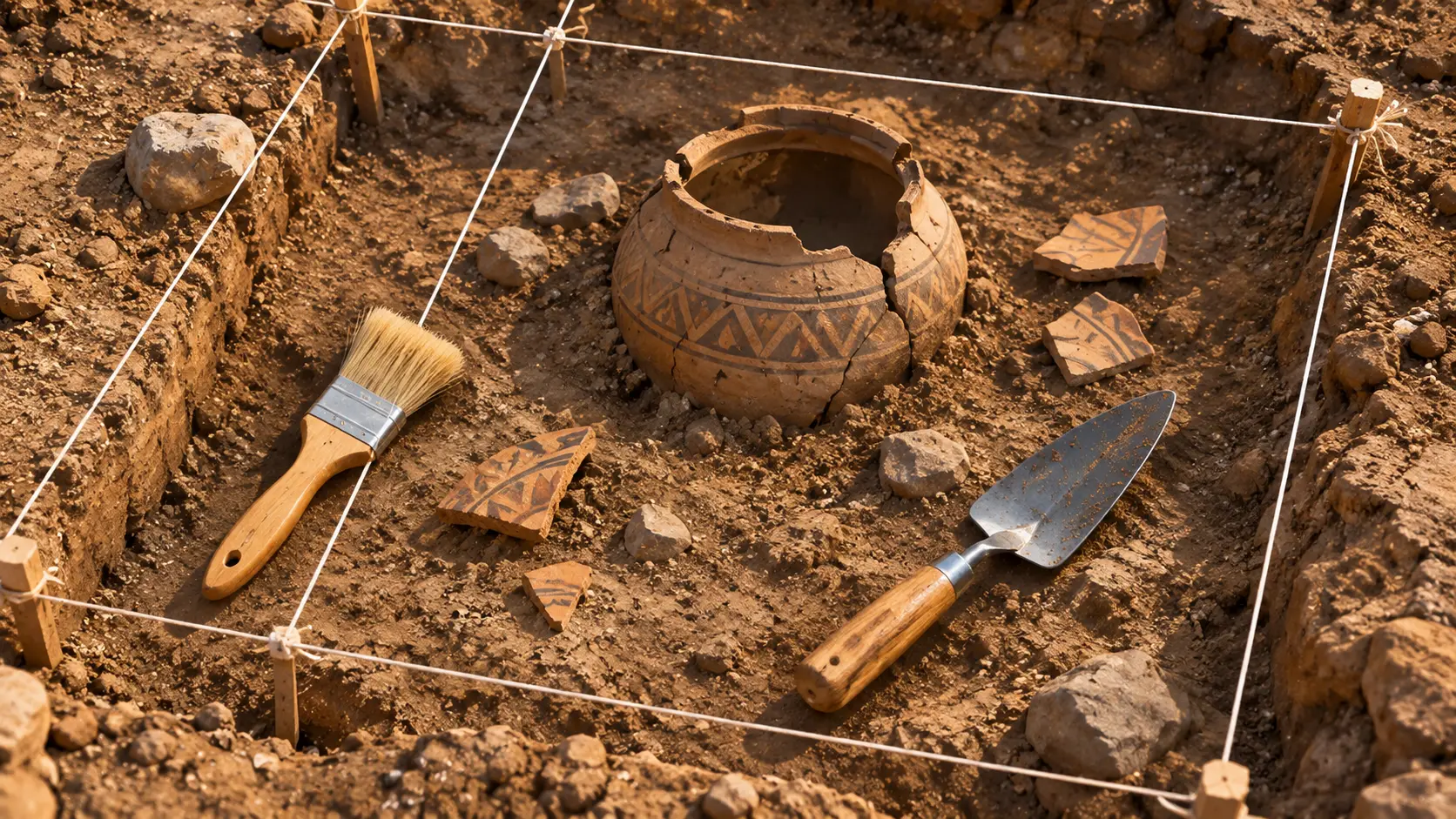
The past leaves things behind
Think about your own life. If someone wanted to understand what you did last year, they could look at photographs, drawings, messages, school projects, tickets from places you visited, or objects in your room. They might even ask your family and friends what they remember.
People who lived hundreds or thousands of years ago left behind similar kinds of evidence, although often much less of it.
An ancient city might contain houses, roads, tools, cooking pots, jewelry, and the remains of food. These objects can tell us what people ate, how they built their homes, what they made, and what kinds of work they did.
Written records provide another kind of evidence. Letters, laws, diaries, business records, and inscriptions can tell us what people said, what they wanted, what they believed, and how they organized their societies.
Even pictures can be valuable. Paintings, carvings, mosaics, and sculptures show us how people dressed, what they considered important, and how they wanted to represent the world around them.
Every object is a possible clue, although understanding what it means often takes careful investigation.
What if there are no written records?
Some of the most interesting periods of human history happened before people developed writing.
How do we know anything about those times?
Archaeologists study the physical remains people left behind. They dig carefully at ancient settlements, examine objects they find, and investigate the remains of buildings, graves, tools, and other structures.
For example, finding animal bones near the remains of an ancient home can help scientists understand what people ate. The shape of a stone tool may reveal how it was used. Traces of seeds and grains can show which plants people grew, while the remains of houses can tell us whether families lived together in small communities or larger settlements.
Sometimes scientists can even study tiny traces that are almost invisible to the naked eye. Pollen preserved in ancient soil can reveal which plants grew in an area thousands of years ago. Chemical traces on old cooking pots can provide clues about the foods people prepared.
By putting these discoveries together, researchers can learn about societies that existed long before anyone wrote down their stories.
How do we know how old something is?
Finding an ancient object is exciting, but knowing when it was made is just as important.
Imagine discovering a wooden bowl. It could be 50 years old, 500 years old, or much older. Looking at it alone might not tell you the answer.
Scientists use several methods to estimate the age of objects and archaeological sites.
One method is to examine where an object was found. At many archaeological sites, deeper layers of soil are older than the layers above them, because new material gradually accumulates over time. If an object is found beneath another layer, its position can provide a clue about its age.
Scientists can also study the materials themselves. A method called radiocarbon dating can help estimate the age of once-living materials, such as wood, bones, and seeds. It works by measuring how much radioactive carbon remains in the material after the organism has died.
Other scientific methods can date rocks, minerals, and the materials used to build ancient structures.
These techniques allow researchers to establish timelines and understand which events happened earlier or later, even when no written records exist.
Are old stories and documents always true?
Suppose two people witnessed the same event but remembered it differently. One person might describe it as frightening, while another remembers it as exciting. Neither person necessarily intends to mislead anyone, but their experiences and memories are different.
The same problem appears when historians study the past.
A king might describe a battle as a great victory, while an ordinary soldier who fought in it might describe terrible losses. A traveler might write about a foreign city with great admiration, while someone who lived there might have a very different opinion.
This is why historians don't simply believe everything they find in an old document. They ask who created it, when it was made, what the person knew, and why they might have described events in a particular way.
A document written by someone who witnessed an event is called a primary source. It gives us a direct connection to the period being studied, although it may still reflect only one person's experience or point of view.
A history book written hundreds of years later is a secondary source. It uses evidence from the past to explain what happened and why.
Both can be useful, but historians need to understand what each source can and cannot tell them. The National Council on Public History explains how historians compare different kinds of evidence and consider the people and circumstances behind each source.
What happens when different clues tell different stories?
Imagine archaeologists discover an ancient city. They find beautiful houses, expensive jewelry, and evidence of busy trade. At first, the city might look like a wealthy and successful place.
But then they discover something else: many houses were abandoned suddenly, and there are signs that the city experienced a serious fire.
What happened? Was there a war? Did an earthquake destroy the buildings? Did people leave because food and water became difficult to find?
The archaeologists cannot simply choose the explanation they like best. They need to examine more evidence.
They might study the remains of buildings, look for signs of earthquakes, examine nearby settlements, or search for written records from the same period. Each new discovery can help them rule out some explanations and support others.
Sometimes researchers reach a strong conclusion. In other cases, several explanations remain possible because there isn't enough evidence to know exactly what happened.
That is an important part of studying history: we can learn a great deal about the past, but we don't always have enough information to answer every question.
Some people leave more traces than others
There is another problem historians need to think about. Not everyone in the past left behind the same amount of evidence.
Kings, rulers, and wealthy families often had buildings, monuments, portraits, and written records created about them. Ordinary farmers, workers, servants, and children may have left much less.
This can make it seem as though history is mostly about famous people and powerful rulers, even though most people who ever lived were neither.
Archaeology helps fill some of these gaps. Everyday objects, cooking tools, children's toys, homes, clothing, and food remains can reveal how ordinary people lived, even when their names and personal stories have been lost.
Historians also work with communities whose histories were passed down through spoken stories, traditions, and memories rather than written documents.
The more kinds of evidence we examine, the more complete and varied our understanding of the past becomes.
History is a little like solving a mystery
Think about the ancient coin from the beginning of this article. By itself, it may tell us only a few things. We might recognize the ruler's face, identify the metal, and estimate when it was made.
But what if we find many coins from the same period, along with the remains of a marketplace, storage buildings, and objects that came from distant places?
Now we can begin to understand something much bigger. Perhaps the city was an important trading center. Perhaps merchants traveled there from far away, bringing goods and ideas from different cultures.
One clue leads to another, and the picture becomes clearer.
This is how historians and archaeologists work. They don't simply collect old things. They ask questions, look for connections, compare different explanations, and use evidence to understand how people and societies changed over time.
And sometimes a new discovery changes what we thought we knew.
You can investigate history too
You don't need to visit an archaeological site to start thinking like a historian. Your own family can provide an interesting collection of clues about the past.
Look at an old photograph of your parents or grandparents. What can you learn from their clothes, the furniture, the buildings, or the objects around them? What might the photograph tell you about the time when it was taken?
Then ask someone who was there to tell you the story behind it. You may discover that the photograph doesn't show everything that happened, and that the story you hear adds details you could never have guessed from the picture alone.
Try comparing what the photograph shows with what the person remembers. Are there things they remember that aren't visible? Are there details in the picture that they hadn't thought about for years?
You have just done something very similar to what historians do when they investigate the past.
Explore it together
Choose an old object from your home. It could be a photograph, a coin, a piece of clothing, a toy, or something that belonged to an older family member.
Pretend you are historians who have just discovered it. Ask what it is made of, how it was used, who might have owned it, and what it tells you about the time when it was created.
Then think about what you still don't know. What questions could you ask someone? What other evidence would help you understand its story?
The goal is not to guess everything correctly. It is to discover how much we can learn from the things people leave behind.
How Sapienta can help
A question about how we know the past can lead to archaeology, ancient civilizations, inventions, famous people, discoveries, and the everyday lives of people who lived long before us.
Sapienta helps parents follow those connections. It considers what a child has already explored, along with their age and interests, and helps find another idea that builds naturally from what they already know.
You don't need to plan the whole journey yourself. Start with a question about the past, and let curiosity lead to the next one.
Raise curious, knowledgeable kids.