
Roots and shoots have different jobs
A young plant has two very different problems to solve.
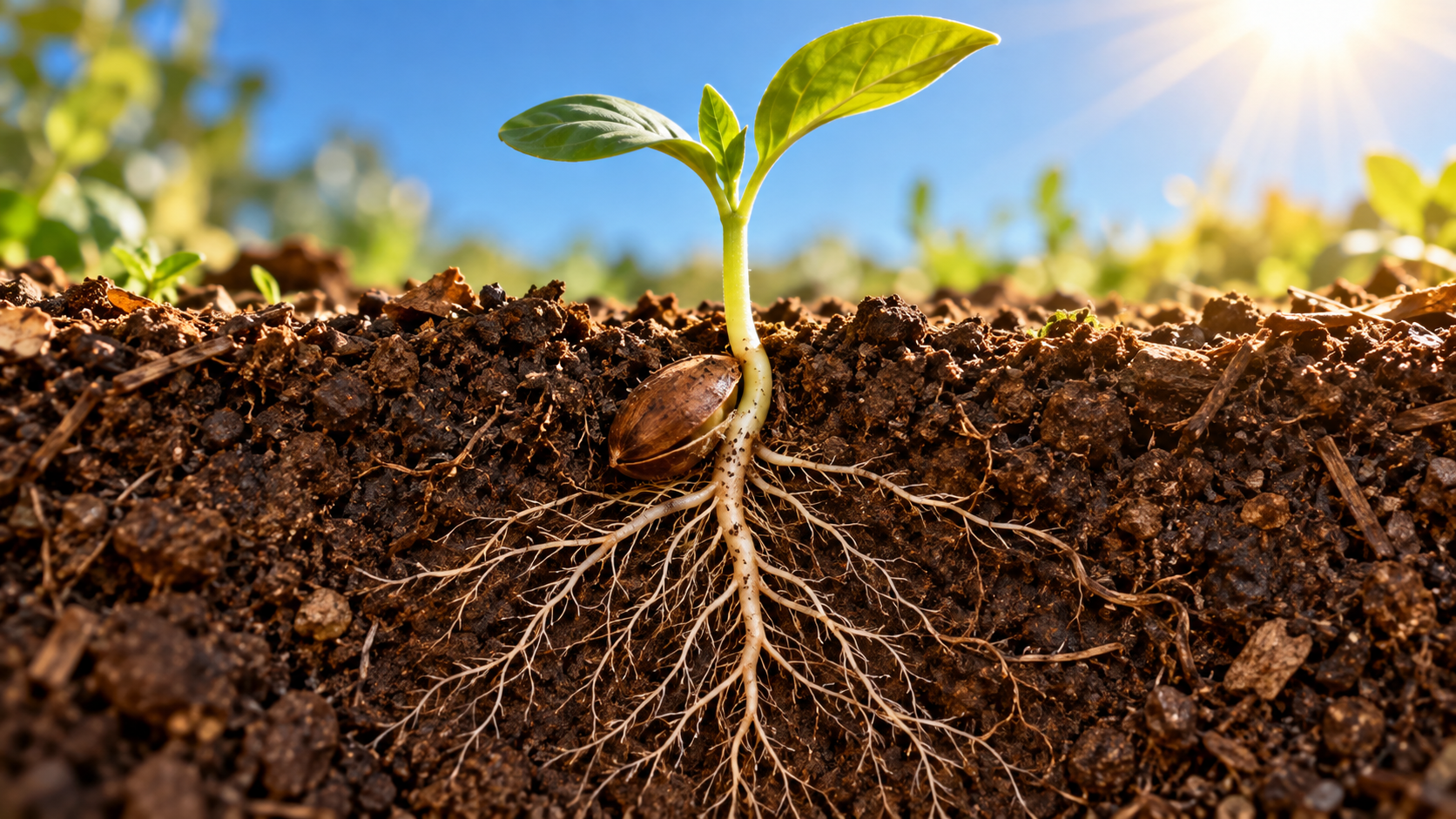
Its roots need to get into the soil, where they can take in water and minerals and help anchor the plant. Its stem and leaves need to reach above the ground, where the leaves can receive sunlight.
So the two parts grow in different directions.
Roots generally grow downward, following the direction of gravity. Shoots generally grow upward, away from the pull of gravity. Scientists call these responses gravitropism, but you can think of them simply as the plant responding to gravity as it grows.
The plant isn't making a conscious decision to turn left or right. Instead, certain cells can sense which direction gravity is pulling, and chemical signals inside the plant change the rate at which different parts of the growing tissue get longer.
That small difference in growth can make a root curve downward or a shoot bend upward.
What happens if you turn a plant on its side?
You can actually see this response for yourself.
Imagine a small plant growing normally on a windowsill. Carefully place it on its side. At first, the stem will still point in the direction it was already growing. But after some time, the growing part of the stem begins to curve upward.
The plant hasn't moved its whole body. Instead, the new growth has gradually changed direction.
The same thing happens underground. If a young root is turned sideways, it can change its direction and begin growing downward again.
This is useful because a plant can't pick itself up and move somewhere else. If a seed lands on its side, gets covered by soil, or is disturbed by something in its environment, the ability to adjust its growth direction can help it find the right place.
Why does a plant care about light?
Once a shoot reaches the surface, another problem becomes important.
Plants need light to make their own food through a process called photosynthesis. Leaves capture energy from sunlight and use it to help turn water and carbon dioxide into sugars that provide energy for the plant.
So getting access to light is extremely important.
If a plant grows in a forest, for example, it may have to compete with other plants for sunlight. If a tree blocks the light from one side, a smaller plant may grow toward the brighter side instead.
You can see this in a house, too. Put a plant near a window and, over time, its stem may lean toward the light.
This response is called phototropism. Plants can sense the direction of light and adjust their growth so that their shoots bend toward it. OpenStax describes how plants use light-sensing systems to direct growth toward a light source.
The plant doesn't move toward the light like an animal would
This is an important difference.
If you want to get closer to a sunny window, you can simply walk there. A plant can't do that. It stays rooted in one place.
Instead, it changes where and how quickly its cells grow.
When light comes mainly from one side, chemical signals inside the stem cause cells on one side to grow differently from cells on the other side. As a result, the stem gradually bends toward the light.
The plant isn't turning its whole body. It is growing itself into a better position.
That may sound slow compared with an animal moving across a room, but plants have plenty of time. A small change in growth repeated over many hours can eventually move a stem or leaf quite a long way.
What happens underground?
Roots have a different goal.
They generally grow away from light and downward into the soil. The soil provides water and minerals that the plant needs, and the roots also help hold the plant in place.
A root doesn't simply grow straight down forever. It branches, changes direction, and explores the surrounding soil. Its growth responds to several things in its environment, including gravity, water, obstacles, and the physical properties of the soil.
This makes a plant much more responsive than it might first appear.
It may look as though a tree is standing still, but underneath the ground its roots are constantly growing and adjusting while the branches and leaves above ground respond to light and other conditions.
How does a plant sense anything without a brain?
This is perhaps the most surprising part.
Plants don't need a brain to respond to their surroundings. Their individual cells can detect changes, and chemical signals can carry information from one part of the plant to another.
You can think of these signals as messages moving through the plant.
When the plant detects light coming from one direction, for example, the cells involved in growth respond differently on different sides of the stem. When a plant is tilted, gravity changes how certain cells are positioned, and this helps the plant adjust its growth.
The result can look almost as if the plant knows what it is doing.
But there is no little control center inside the plant making decisions. The behavior emerges from many cells sensing conditions and responding to chemical signals.
Plants can respond to much more than light and gravity
Light and gravity are two of the easiest responses to observe, but plants can detect and respond to many other changes.
Some plants respond when something touches them. Vines can use contact with nearby objects to help them climb. Certain plants can respond to changes in temperature, water availability, and the length of day.
Plants also respond to damage, attacks from insects, and other changes in their environment.
The more scientists study plants, the more complicated their lives turn out to be. They may not have brains or eyes, but that doesn't mean they simply sit there doing nothing. They are constantly responding to the world around them.
Try an experiment at home
This is one of those science questions you can investigate without special equipment.
Take a small plant and place it near a window where light mainly comes from one direction. Take a photograph every day for a week.
Does the stem change direction?
You can also place a germinating seed inside a transparent container with some damp paper towel. As the root and shoot grow, watch which direction each one takes.
If you carefully turn the container, you can observe how the growing plant responds over time.
Instead of simply telling your child that plants grow toward light, let them make a prediction first: What do you think will happen if the light comes from only one side?
Then wait and see.
The plant is doing the experiment for you.
Questions your child might ask next
Why do plants need sunlight? Plants use light as part of photosynthesis, the process that allows them to make sugars from water and carbon dioxide.
How do plants drink water? Roots absorb water from the soil, and the plant moves that water upward through tiny tubes inside its stems.
Why are leaves usually green? Leaves contain chlorophyll, a pigment that helps plants capture light for photosynthesis. Chlorophyll absorbs some colors of light more strongly than others, which makes leaves appear green.
Why do some plants grow toward each other? Plants may grow toward light, water, or other useful resources, while some climbing plants also respond to nearby objects that they can use for support.
Explore it together
Find a plant near a window and look at it from different angles. Which direction are most of its leaves pointing? Is the stem growing straight upward, or has it begun to lean?
Then look at a tree outside. Notice how its branches are arranged. Are some branches growing into open space where they can receive more light?
You can even look at plants growing through cracks in sidewalks or around walls. They may appear to be growing in strange directions, but once you start asking what they are responding to, their shapes begin to make much more sense.
How Sapienta can help
A question about a plant growing toward a window can lead to questions about sunlight, photosynthesis, roots, water, gravity, forests, and how plants compete for resources.
Sapienta helps parents follow those connections. It considers what a child has already explored, along with their age and interests, and helps find another idea that builds naturally from what they already know.
You don't need to turn every question into a lesson. Sometimes it is enough to notice something growing beside you, ask why, and see where the question leads.
Raise curious, knowledgeable kids.