
A habitat has to work for the animal
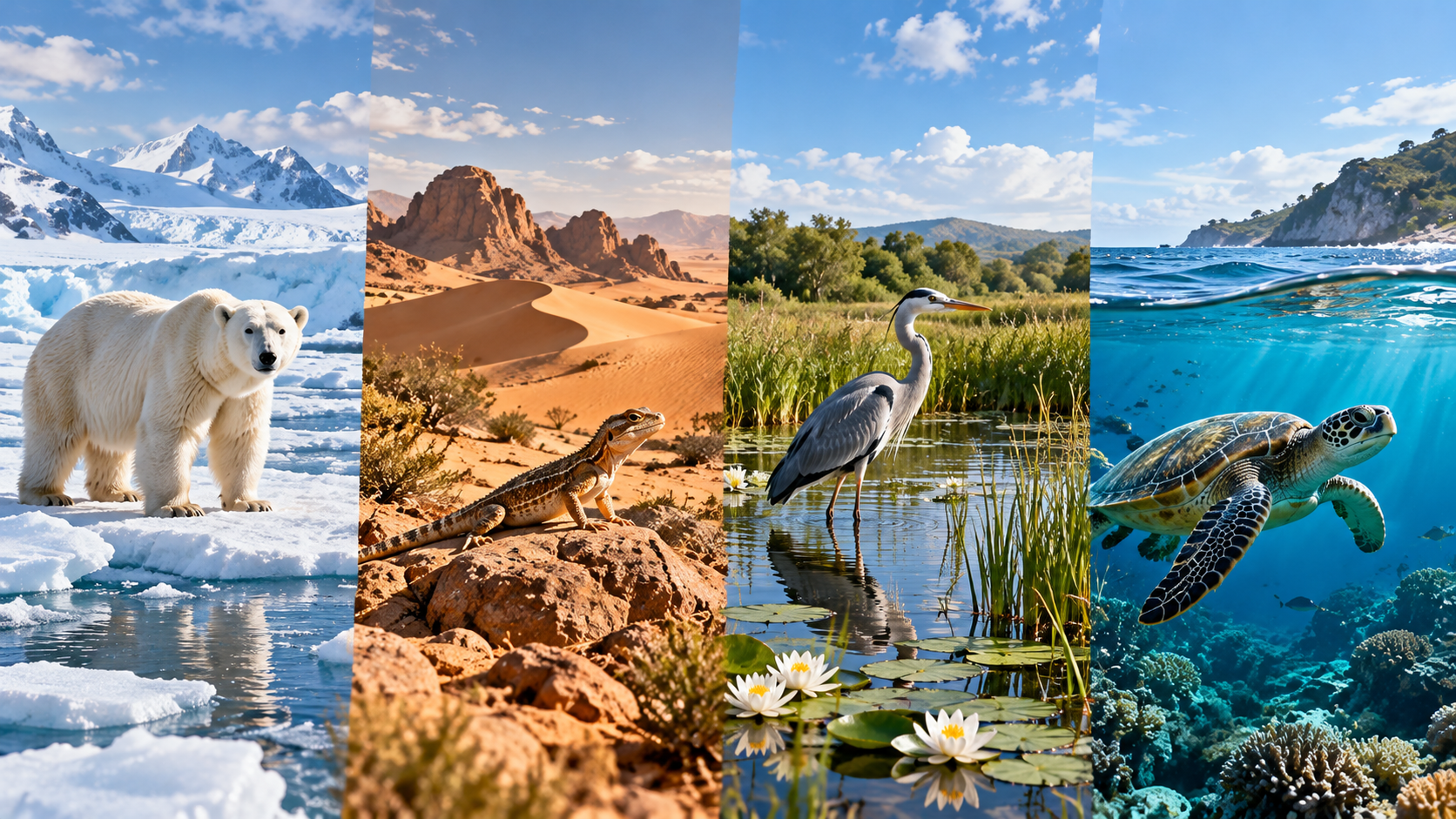
Imagine putting a polar bear in the middle of a hot desert. There might be plenty of open space, but that doesn't mean the desert is a good home for a polar bear. Its body is suited to a cold environment, and its way of finding food depends on the Arctic ecosystem.
Now imagine putting a camel on Arctic sea ice. The camel is much better at dealing with heat and limited water, but it isn't built for life on frozen ocean surfaces, and it wouldn't find the food it needs there.
A habitat isn't simply a place where an animal happens to be found. It is a place that provides the conditions the animal needs to live.
Temperature matters. So does water. Food matters, of course, but so do places to hide from predators, build a nest, raise babies, or escape extreme weather. Even space can matter. A large predator may need a huge area to find enough food, while a tiny insect might spend its entire life in a space smaller than your hand.
Animals are suited to their surroundings
Animals have features that help them live in their particular environments. These features are called adaptations.
Consider a whale. Its body is shaped for moving through water, and its thick layer of fat helps keep it warm in cold seas. An owl has wings for flying, eyes that help it see in low light, and feathers that can help it blend into its surroundings.
A desert animal faces a different set of problems. Water may be difficult to find, temperatures can become extremely high, and food may be spread far apart. Animals that live there have adaptations that help them deal with those conditions.
The Smithsonian National Museum of Natural History uses examples such as whales, clouded leopards, and owls to show how body features and behaviors can help animals survive in particular environments. You can explore some of these adaptations through the Smithsonian's animal resources.
These adaptations didn't appear because an animal decided it needed them. They developed over many generations as inherited differences were passed from parents to their offspring. When a particular trait helped animals survive and reproduce, it could become more common in the population over a very long period of time.
Why can two animals share the same habitat?
You might think that if several animals live in the same forest, they must all be competing for exactly the same things. But a forest can provide many different ways to make a living.
One animal might eat insects hiding under tree bark. Another might eat leaves high in the branches. A third might eat seeds on the forest floor. Some animals might live in the trees, while others spend most of their time underground.
This means a single habitat can contain many different kinds of animals, each using different parts of it.
A forest, for example, isn't just a collection of trees. It contains layers of leaves, branches, trunks, roots, soil, streams, fallen logs, and open spaces. Each part creates opportunities for different living things.
The same idea works in an ocean. Some animals live close to the surface, where sunlight reaches the water. Others live near the seafloor, and some spend their lives moving through the open ocean. They are all in the same enormous habitat, but they experience very different parts of it.
Climate shapes where animals can live
Temperature and rainfall help determine what kinds of plants can grow in a place, and the plants then affect which animals can live there.
A rainforest receives lots of rain and supports enormous numbers of plants. Those plants provide food and shelter for insects, birds, monkeys, frogs, and many other animals.
A desert receives very little rainfall. The plants and animals there have to cope with much less available water.
Farther north and south, the climate can become extremely cold. Animals living in these regions need ways to survive long, cold periods.
Scientists often group large regions with similar climates and living things into biomes, such as deserts, forests, grasslands, and tundra. Within each biome there can still be many different habitats. National Geographic describes how climate and the plants and animals found in an area help define a biome.
This is why geography and biology are so closely connected. Change the climate, landscape, or available water, and the animals that can live there may change too.
What happens when a habitat changes?
Animals can sometimes move to a new place when their environment changes. Some animals do this regularly as part of their normal lives. Others may be forced to move when food becomes scarce or their habitat is damaged.
But moving isn't always easy.
A new place may not have enough food. There might already be other animals competing for the same resources, or the temperature may be wrong. An animal that depends on a particular plant, nesting site, or type of shelter may have nowhere suitable to go.
This is one reason habitat loss can be such a serious problem for wildlife. When a forest is cleared, a wetland dries up, or a coastline changes, an animal may lose much more than the place where it sleeps. It can lose the food, water, shelter, and space that made the whole habitat work.
An animal's home can be surprisingly small
When we hear the word "habitat," we might imagine a huge forest or an entire ocean. But a habitat can be much smaller.
For a frog, a pond and the plants around it may provide almost everything it needs. For a caterpillar, the underside of a particular leaf can provide food and shelter. A bird may depend on a single tree for a nesting site while searching a much larger area for food.
That makes habitats interesting to explore close to home.
A garden, park, pond, or even a patch of grass can contain its own small community of living things. Look closely and you may find insects hiding under leaves, birds searching for food, spiders building webs, and plants providing shelter for tiny animals.
What if an animal moved somewhere completely different?
This is a fun way to think about habitats with a child.
Choose an animal and imagine moving it somewhere else. What would happen if a penguin had to live in a desert? What if a camel lived in a rainforest? What if a frog lived somewhere with almost no water?
Instead of simply saying that the animal couldn't survive, ask why.
Would it find enough food? Would it be too hot or too cold? Could it find water? Would its body still help it move around? Where would it hide? Could it raise its young?
Those questions reveal something important about nature: an animal and its environment are connected. You cannot really understand one without looking at the other.
Questions your child might ask next
Why do animals have different bodies? Animals have different bodies because different ways of living create different challenges. Over many generations, inherited features that help animals survive can become common in a species.
How do animals know what to do? Some behaviors are built into an animal from birth, while others are learned through experience. Many animals use a combination of both.
Why do some animals migrate? Some animals move between different places during the year because food, temperature, or conditions for raising young change with the seasons.
Why do some animals hibernate? Some animals survive difficult periods by becoming much less active and using less energy when food is scarce.
Explore it together
Pick two animals that live in very different environments, such as a camel and a polar bear. Make a simple list of what each one needs from its habitat: food, water, temperature, shelter, and space.
Then choose a third animal that lives somewhere near you. A pigeon, squirrel, lizard, or butterfly can work just as well as an exotic animal.
Look around and ask your child what this animal is getting from its surroundings. Where does it find food? Where does it rest? Where does it hide? What might make this place a good home for it?
You may discover that once you start looking at the world this way, an ordinary park becomes much more interesting.
How Sapienta can help
A question about where an animal lives can lead to questions about its body, its food, the climate, other animals around it, and how all those pieces fit together.
Sapienta helps parents follow those connections. It considers what a child has already explored, along with their age and interests, and suggests new ideas that can build naturally from what they already know.
You don't need to plan every step. Start with the animal your child is curious about, and see where the next question takes you.
Raise curious, knowledgeable kids.