
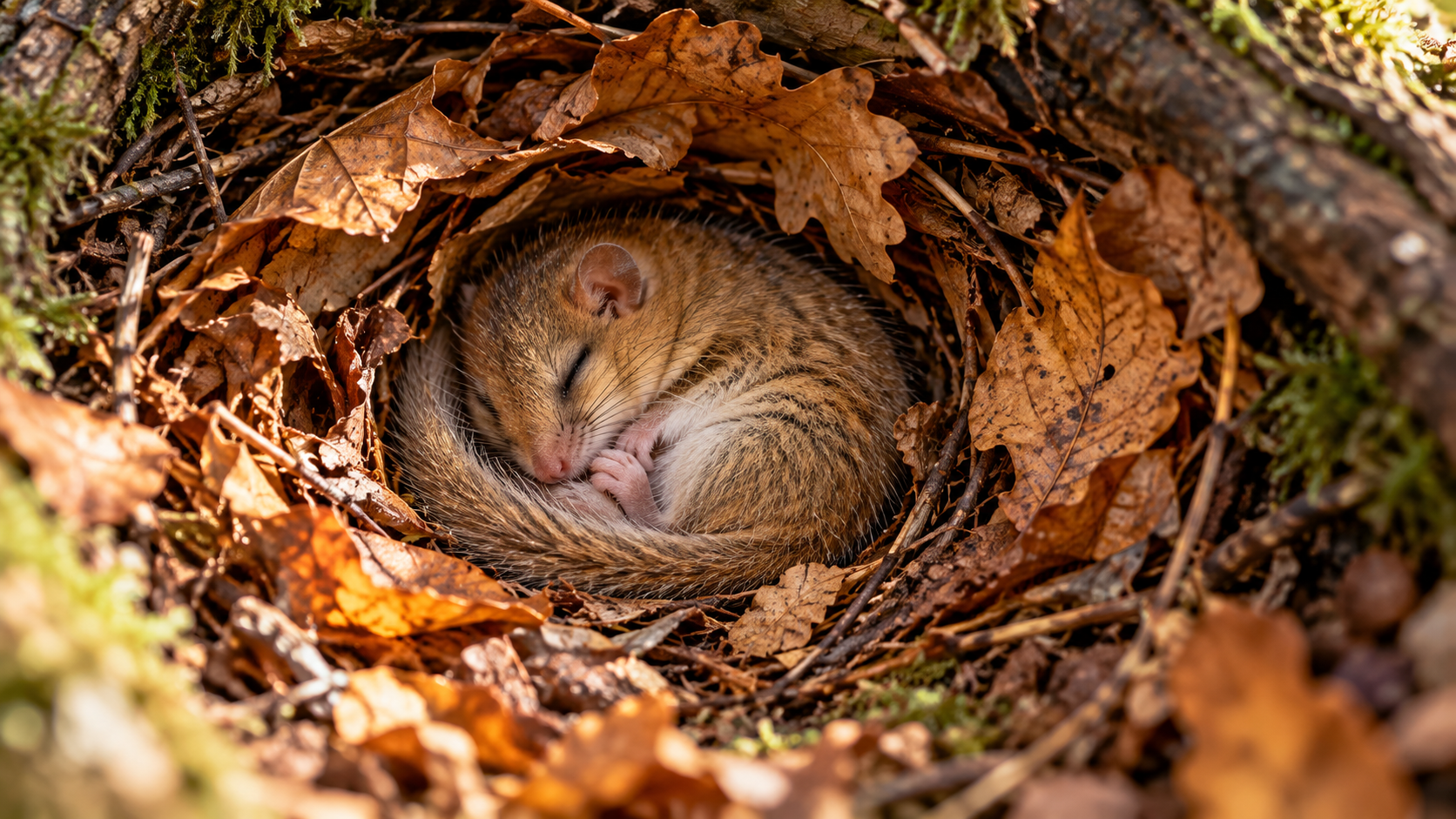
Why would an animal need to hibernate?
Winter creates a difficult problem for many animals: there may simply not be enough food.
In summer, a forest might be full of insects, plants, seeds, berries, and other sources of food. But when temperatures fall, plants stop growing, insects become harder to find, and snow or ice can cover food that was easy to reach before.
An animal could try to stay active and search for food anyway, but that takes energy. Moving around, keeping warm, and searching for something to eat all require fuel.
Hibernation offers another solution. Instead of spending lots of energy looking for food that may not be there, the animal slows its body down and waits for better conditions.
It is a little like putting a machine into a very low-power mode when you know you won't be using it for a while.
The animal's whole body slows down
When an animal enters deep hibernation, remarkable things happen inside its body.
Its heartbeat becomes much slower. It takes fewer breaths, and its metabolism, the collection of processes that keeps the body running, slows down. Some animals also allow their body temperature to fall dramatically.
An Arctic ground squirrel can take this to an extreme. During hibernation, its body temperature can fall below the freezing point of water, although the animal has special adaptations that allow it to survive this extraordinary condition. It can remain in this state for much of the winter before returning to normal activity. National Park Service
The purpose is simple: the slower the body works, the less energy it needs.
Where does the energy come from?
An animal can't spend months in hibernation without a source of energy. Before winter arrives, many animals prepare by eating more and storing energy in their bodies as fat.
Think about a ground squirrel spending the warm months eating as much nutritious food as it can. Some of that food becomes body fat. When winter arrives and the squirrel enters hibernation, it can slowly use that stored energy instead of constantly searching for new food.
Other animals use a different strategy. Some store food rather than storing large amounts of fat. They may spend winter in a sheltered place and wake up from time to time to eat what they have saved.
This means preparation for winter can begin long before the animal disappears from view.
Is hibernation just sleeping?
No. Sleep and hibernation are quite different.
When you sleep, your body continues working at roughly its normal rate. Your heart keeps beating normally, your body temperature stays fairly stable, and you wake up after several hours.
During deep hibernation, an animal's entire body enters a much slower state. Its temperature, heart rate, breathing, and energy use can all drop dramatically.
Some hibernating animals do wake up briefly during the winter. Others remain in a deep state for very long periods.
There is also a broader word, dormancy, for periods when animals greatly reduce their activity. Not every animal that becomes inactive in winter is a true hibernator. Bears, for example, enter a deep winter dormancy in which their metabolism slows, but their body temperature does not fall as dramatically as it does in animals such as ground squirrels. Scientists sometimes distinguish bear dormancy from true hibernation. National Park Service
For children, it is perfectly reasonable to hear that bears "hibernate," as people commonly say. The scientific details are a little more complicated.
Not all animals survive winter in the same way
Hibernation is only one strategy.
Some animals migrate to warmer places or follow the food to another region. Others stay active throughout winter and simply change how they live.
A fox, for example, can remain active while looking for food under very different conditions. Some animals grow thicker fur or feathers. Others change what they eat. Some find shelter underground or beneath snow, where temperatures may be more stable than they are above ground.
Reptiles have their own form of winter dormancy called brumation. Because reptiles cannot produce enough body heat to remain active in very cold conditions, they become much less active and wait for warmer weather. Insects use other forms of dormancy as well. National Park Service
There is no single solution to winter. Different animals have evolved different ways to deal with it.
What happens when spring comes?
Eventually, conditions improve.
Temperatures rise, days become longer, plants begin growing, and insects and other food sources become available again. An animal that has spent months conserving energy can return to normal activity.
For some species, the timing is extremely important. Waking too early could mean that there is still not enough food. Waiting too long could mean missing an important opportunity to feed, mate, or raise young.
The animal's body responds to signals from its environment, including changes in temperature and daylight. Its internal systems help determine when it is time to become active again.
In this way, hibernation is connected to the changing seasons. The animal isn't simply sleeping through winter because it is tired. Its body is responding to a predictable period when the conditions for being active are much worse.
Why don't all animals hibernate?
Because hibernation only helps if it solves a problem.
If an animal can find enough food throughout winter, it may have no reason to enter hibernation. If it can migrate to another place where food is plentiful, migration may be a better strategy. If its body is already well suited to cold conditions, it may simply remain active.
Bats provide a good example. Some species hibernate when cold weather makes insects scarce, while others migrate to warmer areas where they can continue finding food. Some species can use either strategy depending on where they live. National Park Service
The interesting question is therefore not simply, "Does this animal hibernate?" It is "How does this animal survive when its environment becomes difficult?"
That question can lead to many different answers.
You can look for winter strategies around you
You don't need to find a hibernating animal to explore this idea.
Take a walk in winter and look for signs of animals. Are there fewer insects than you noticed in summer? Are some birds still around while others have disappeared? Can you find tracks, nests, burrows, or food that animals might be using?
Then think about what each animal might be doing.
Perhaps it has migrated. Perhaps it is still active but eating different food. Perhaps it is sheltered somewhere. Or perhaps it has entered a dormant state and is waiting for spring.
You can even compare the same animal in summer and winter. What changes? What stays the same? What problem does winter create, and how does the animal deal with it?
Once you start looking at winter this way, the quietness of the season can become a clue. Animals haven't simply vanished. Many are using different strategies to get through a difficult time.
Questions your child might ask next
Why do some animals migrate? Some animals move to different places when seasons change because food, temperature, or conditions for raising their young are better somewhere else.
How do animals know what to do? Some behaviors are inherited, while others are learned through experience. Animals also respond to information from their surroundings.
Why do animals live in different places? Different habitats provide different combinations of food, water, shelter, temperature, and space, so animals are suited to different environments.
Why do animals have different bodies? Different animals face different challenges, and over many generations their bodies have developed features that help them survive in the environments where they live.
Explore it together
Choose two animals that deal with winter in completely different ways. You could compare a hibernating ground squirrel with a bird that migrates, or a hibernating bat with a fox that stays active.
Ask what problem winter creates for each animal. Is food harder to find? Is it too cold? Does the animal need to protect its young?
Then ask how each animal solves the problem.
One sleeps through much of the difficult period. The other moves somewhere else. Another might simply stay and adapt.
There is no single "right" way to survive winter, and that is part of what makes the natural world so interesting.
How Sapienta can help
A question about hibernation can lead to much bigger questions about seasons, food, body temperature, migration, animal behavior, and the ways living things adapt to their environments.
Sapienta helps parents follow those connections. It considers what a child has already explored, along with their age and interests, and helps uncover another idea that builds naturally from what they already know.
You don't need to plan the whole journey yourself. Start with the question your child is asking today, and let curiosity lead to the next one.
Raise curious, knowledgeable kids.