
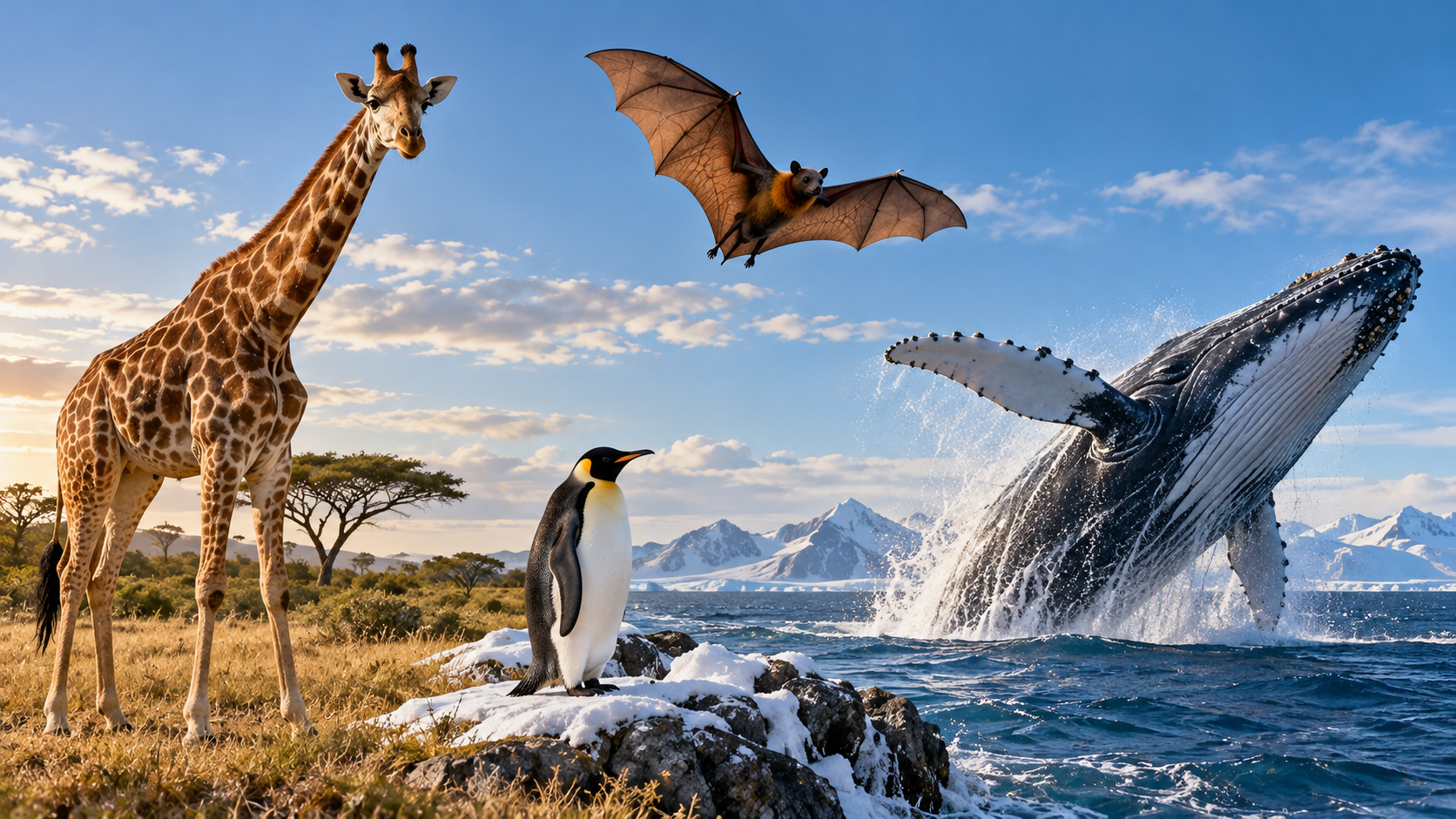
A body is shaped by the way an animal lives
Think about where a penguin spends its time. It needs to move through water, catch fish, stay warm, and survive in a very cold environment. Its body is shaped around those challenges. Its wings work like flippers in the water, its body is streamlined so it can swim efficiently, and its feathers and layer of fat help keep it warm.
Now imagine a giraffe living on the African savanna. It faces a very different set of challenges. Its long neck allows it to reach leaves high in trees, while its long legs help it move across open ground. A giraffe doesn't need a body that works like a penguin's because it has a completely different way of making a living.
This is one reason there is no single "best" animal body. A feature that is extremely useful in one place might be almost useless somewhere else.
Why do birds have different beaks?
Birds give us a great example of how bodies can be shaped by what an animal eats.
A hummingbird has a long, narrow beak that helps it reach into flowers for nectar. A hawk has a strong, curved beak that helps it tear food apart. A duck has a broad, flatter bill that it can use to find and handle food in water or mud.
These birds are all related, but they make a living in different ways. Their beaks are part of the tools their bodies have developed for their particular lifestyles.
You can think of an animal's body as a collection of tools. Teeth, claws, beaks, wings, fins, shells, fur, feathers, and even the shape of an animal's body can all help it deal with the challenges of its environment.
Why don't animals simply change when they need to?
This is where the story gets especially interesting.
An individual animal cannot decide that it needs a longer neck and then grow one. A penguin cannot move to a colder place and suddenly grow thicker feathers.
Instead, animals within the same species are naturally a little different from one another. These differences come partly from their genes, the instructions that help build and operate their bodies. Some differences can make an animal better suited to its surroundings.
Imagine that a group of animals lives somewhere where food is mostly found high above the ground. If some members of that species happen to have slightly longer necks, they may be able to reach food that others cannot. If those animals survive and have more offspring, the traits they pass on can become more common over many generations.
This process happens incredibly slowly. It can take thousands or millions of years, and it does not happen because animals are trying to change themselves. Instead, small inherited differences are passed from generation to generation, and some happen to work better in a particular environment.
That is one of the central ideas behind evolution.
What about animals that live in the same place?
Even animals sharing the same habitat can have very different bodies because they may use the environment in completely different ways.
A forest might be home to a woodpecker, a squirrel, a snake, and a deer. The woodpecker can climb tree trunks and use its strong beak to find insects. The squirrel can climb and jump between branches. The snake can move along the ground and through narrow spaces without legs. The deer can travel quickly across the forest floor and use its mouth to eat leaves and plants.
They are all using the same forest, but they are not looking for the same food, moving in the same way, or avoiding danger in the same way.
In a healthy ecosystem, this variety can allow many different animals to live in the same area without all competing for exactly the same things.
Sometimes a strange body part has an unexpected story
Some animal features are so unusual that they make you wonder what they are for.
Why does an elephant have such a long trunk? Why does a duck have webbed feet? Why does a camel have such a large hump? Why do some animals have enormous ears?
Often, the answer becomes clearer when you look at the animal's way of life.
An elephant's trunk can be used for breathing, smelling, touching, drinking, and picking things up. A duck's webbed feet help it push against water when it swims. Large ears can help some animals release heat in hot environments.
And sometimes a body feature that originally developed for one reason can later become useful for something else. Feathers, for example, were not simply invented for flight. They likely had earlier functions, including helping with warmth, before some animals eventually evolved feathers that were useful for flying.
Nature is full of these stories. A body part does not always have just one job.
Why don't all animals look more alike?
Because there are many different ways to survive.
Some animals run. Others fly. Some swim. Some burrow underground. Some climb trees. Some spend most of their lives in darkness. Some eat plants, while others hunt animals, and some survive by eating both.
Their surroundings also differ enormously. There are frozen polar regions, hot deserts, deep oceans, tropical forests, grasslands, mountains, caves, and many environments in between.
Over very long periods of time, animals living in these different places have followed different evolutionary paths. Their bodies have become increasingly suited to the particular challenges they face.
That is why looking at an animal can tell us something about its world. A body is often a clue.
Look at an animal like a scientist
The next time your child sees an animal, try looking at it without immediately asking what it is called.
Instead, ask: What can you learn from its body?
Look at its feet. Are they made for climbing, swimming, running, digging, or gripping?
Look at its mouth. What kind of food might it be able to eat?
Look at its eyes. Where are they positioned on its head, and what might that tell you about how it finds food or notices danger?
Look at its covering. Does it have fur, feathers, scales, or a shell? How might that help it live where it does?
Then try a harder question: What would you change about this animal if it suddenly had to live somewhere completely different?
A penguin moving into a hot desert would face very different problems from a penguin living in Antarctica. A camel would have a very different life if it had to spend all its time underwater.
The interesting part is that these questions don't have to stop with animals. They lead naturally to habitats, food webs, climate, evolution, and the remarkable variety of life on Earth.
Questions your child might ask next
Why do animals live in different places? Different animals are suited to different environments, depending on what they need for food, shelter, temperature, water, and reproduction.
How do animals know what to do? Animals are born with some behaviors, while others are learned through experience. This makes the question of animal behavior much more complicated than it first appears.
Why do some animals migrate? Some animals move from one place to another when seasons change, often to find food, reproduce, or reach environments where conditions are better.
Why do some animals hibernate? Some animals enter a state of greatly reduced activity during difficult seasons, allowing them to use much less energy when food is scarce.
Explore it together
Choose three animals that live in very different environments. A polar bear, a camel, and a dolphin would make a good combination.
For each one, ask the same questions: Where does it live? What does it eat? How does it move? How does it stay warm or cool? How does its body help it survive?
You may find that once you start looking closely, an animal's body stops looking like a collection of random features. Its shape begins to tell a story about the life it leads.
How Sapienta can help
A question about an animal can open the door to much more than learning the animal's name. A child's curiosity about a penguin's wings might lead to questions about flight, swimming, Antarctica, feathers, evolution, or why birds are related to dinosaurs.
Sapienta helps parents follow those connections. It takes into account what a child has already explored, along with their age and interests, and helps uncover another question worth exploring.
You don't need to know where the conversation should go next. Start with the animal your child is curious about, and let the questions grow from there.
Raise curious, knowledgeable kids.