
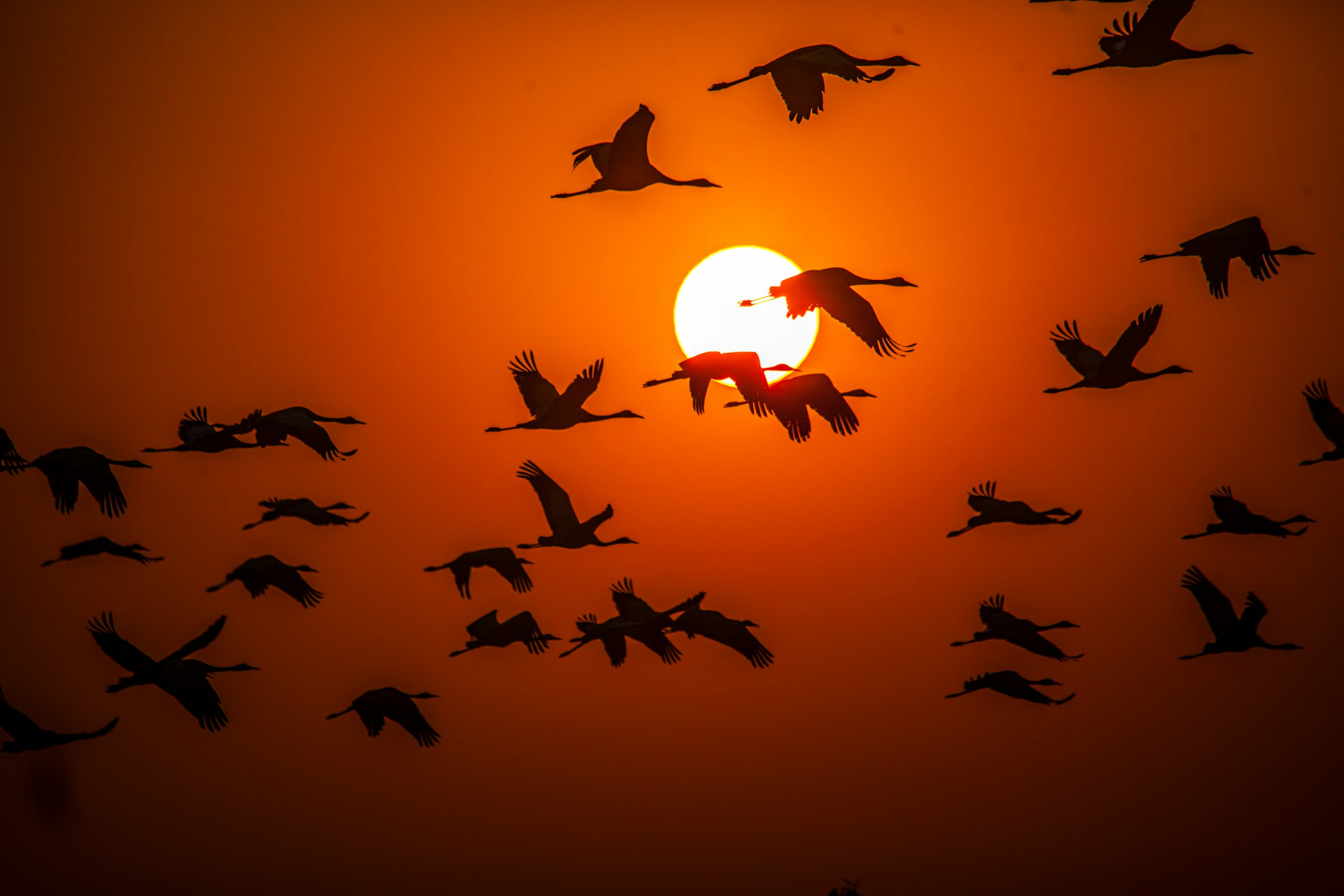
The seasons change the world around animals
Imagine living in a place where food is plentiful during summer but almost impossible to find during winter.
Plants grow during the warmer months, insects appear, rivers may fill with water, and many animals have plenty to eat. Then the season changes. Plants stop growing, insects become scarce, snow covers the ground, or the water freezes.
An animal that stays in the same place may suddenly have a much harder time finding enough food.
For some animals, moving to another place is a better solution than trying to survive the difficult season. When spring arrives and conditions improve again, they can return.
This is why migration is closely connected to the seasons. As temperature, daylight, rainfall, and food availability change, animals respond to those changes in different ways.
Food is one of the biggest reasons animals move
Food does not stay in the same place all year.
Insects may become abundant in one region during spring. Plants may produce fresh leaves during summer. Fish may gather in particular areas at certain times of year. When those food sources appear, animals that depend on them may travel to take advantage of them.
Consider a bird that feeds its chicks on insects. During one part of the year, its breeding grounds may be full of insects, making it an excellent place to raise young. Later in the year, the insects become much less common. Another region may then provide better food.
The bird is not simply escaping cold weather. It is following a changing supply of food.
Some large mammals do something similar. In Yellowstone, for example, animals such as elk and bison move through different elevations during the year, following the growth of fresh, nutritious plants as the seasons change.
Migration can therefore be thought of as a way of following a moving food supply.
Sometimes the best place to eat isn't the best place to have babies
Finding food is important, but animals also need places where they can reproduce and raise their young.
A place that provides excellent food for part of the year may not be safe or suitable for raising babies. Another location might offer better nesting sites, warmer conditions, fewer predators, or more space.
This is why some animals travel between two very different places during the year. One place may be particularly good for raising young, while another provides better conditions during the rest of the year.
Migratory birds are a good example. Many species travel to particular regions to breed, then move to other regions where food and conditions are better during another season.
The journey itself can be difficult, but the benefits of reaching the right place at the right time can make the journey worthwhile.
Migration can be an enormous journey
Some migrations are surprisingly long.
Arctic terns travel between the Arctic and Antarctica each year, following a route that can total more than 24,000 kilometers. Caribou in Alaska can travel thousands of kilometers between their summer and winter ranges. Salmon make remarkable journeys from the ocean back into rivers, where they reproduce.
Other migrations are much shorter.
An animal might move from a mountain to a valley when winter arrives, or travel a relatively short distance to reach a pond where it can reproduce.
So migration doesn't necessarily mean crossing a continent. What matters is that the animal makes a regular movement between different areas because each area offers something important at a particular time.
How do animals know when to leave?
This is one of the most fascinating parts of migration.
Animals don't have calendars hanging on their walls, but many can detect changes in their surroundings that tell them the seasons are changing.
Changes in daylight are important for many species. Temperature, rainfall, food availability, and other environmental signals can also provide information.
For some animals, the timing of migration is partly inherited. Young animals may be born with tendencies that help guide when they should begin a journey. In other species, young animals learn important parts of the journey by following older animals.
Different animals also use different clues to find their way. Some birds use the position of the Sun and stars. Some animals can sense Earth's magnetic field. Salmon can use their sense of smell to help them return to the streams where they were born, while some mammals learn migration routes from their mothers and other members of their group.
Scientists are still learning exactly how different animals combine these clues.
Migration takes a lot of energy
Traveling long distances is hard work.
Before some birds migrate, they eat more food and store extra energy in the form of fat. That stored energy acts like a fuel supply during the journey. Some birds also change what they eat before migration, choosing foods that help them build up energy reserves.
Other animals prepare in different ways. Some build up body fat, while others take advantage of seasonal food that appears along their route.
This also explains why migration can be risky. An animal may have to cross mountains, rivers, oceans, or areas where predators are waiting. If food disappears along the route, the journey becomes even harder.
Migration is therefore a trade-off. The journey costs energy and carries risks, but reaching another place at the right time can give an animal access to food, shelter, or better conditions for reproduction.
Why don't all animals migrate?
If migration is so useful, why don't all animals do it?
Because staying put can also be a good strategy.
Some animals have bodies and behaviors that allow them to survive the changing seasons where they already live. A fox, for example, can remain in the same general area throughout the year because its body and behavior help it cope with both summer and winter.
Other animals may store food, grow thicker fur, become less active, or change what they eat when conditions change.
Migration is just one of many ways animals deal with a changing world. Different species have evolved different strategies, depending on the environments they live in and the resources available to them.
Migration connects animals to entire ecosystems
A migrating animal does more than move from one place to another.
When huge numbers of animals arrive somewhere, they can affect the plants, predators, scavengers, and other animals around them. Migrating caribou, for example, transport nutrients across large areas as they move and feed. Salmon bring nutrients from the ocean into rivers and surrounding ecosystems when they return to reproduce.
This means migration can connect places that may seem completely separate.
An animal might spend one part of the year in one ecosystem and another part thousands of kilometers away. What happens in either place can affect its survival.
That makes migration a useful reminder that nature is connected across surprisingly large distances.
Watch for migration around you
You don't need to travel to Africa or the Arctic to see migration.
Birds migrate through many parts of the world, and you may notice that some birds appear during one season and disappear during another. Insects can migrate too, as can fish, mammals, and other animals.
Try keeping track of animals you notice in your area throughout the year. Which ones seem to appear only during certain seasons? When do they arrive? When do they disappear?
Then ask a bigger question: What might be changing in the environment at the same time?
Perhaps insects become more common. Perhaps plants begin flowering. Perhaps the weather changes or daylight lasts longer.
You may start to see migration not as a mysterious journey, but as part of a much larger pattern connecting animals to the changing seasons.
Questions your child might ask next
How do animals know where to go? Different animals use different clues. Some use the Sun, stars, smells, landmarks, or Earth's magnetic field, while others learn routes from older members of their group.
Why do some animals hibernate? Some animals survive difficult seasons by becoming much less active and using less energy when food is scarce.
Why do animals live in different places? Different environments provide different combinations of food, water, shelter, temperature, and space, and animals have adaptations that help them survive in particular habitats.
How do animals know what to do? Some behaviors are inherited, while others are learned through experience and observation. Migration can involve both.
Explore it together
Pick a migratory animal and trace its journey on a map. Find out where it spends different parts of the year and then ask why it might need both places.
A bird is a good starting point, but you could also choose a whale, salmon, caribou, butterfly, or another migratory animal.
Try to follow the journey as a series of questions: Where does it go? What does it find there? Why does it leave? What would happen if the food it depends on appeared earlier or later than usual?
That last question can lead to an especially interesting conversation because migration depends on timing. If an animal arrives after its main food source has disappeared, a journey that normally works very well can suddenly become much harder.
How Sapienta can help
A question about migration can lead naturally to questions about seasons, habitats, food, navigation, climate, and animal behavior. One journey can reveal connections between places thousands of kilometers apart.
Sapienta helps parents follow those connections. It considers what a child has already explored, along with their age and interests, and helps find another idea that builds naturally from their growing understanding.
You don't need to plan the whole journey yourself. Start with the animal your child is curious about, and let the next question lead somewhere new.
Raise curious, knowledgeable kids.