

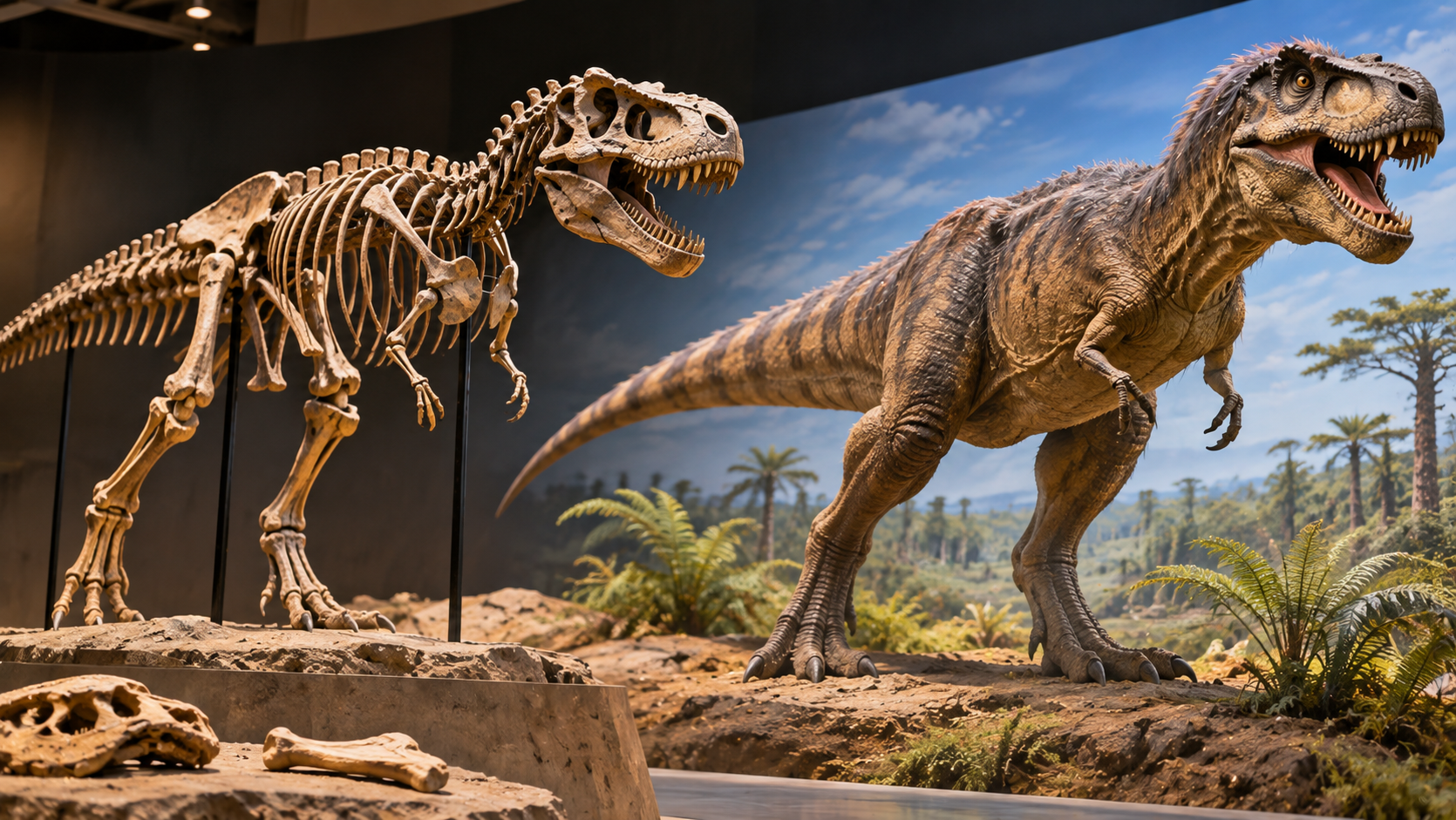
The bones tell the beginning of the story
The most familiar dinosaur fossils are bones. When a dinosaur died, its remains sometimes became buried under mud, sand or other sediments. Over a very long time, minerals could replace or fill parts of the bones, preserving their shapes inside rock.
Millions of years later, scientists might discover these fossils and carefully uncover them. They examine the shape of each bone, its size and how it connects to other bones.
A skull, for example, can reveal a great deal about an animal. Its teeth may show whether the dinosaur ate plants or meat. The shape of its jaws can provide clues about how it chewed, while the position of its eyes can help scientists understand how it saw the world.
Leg bones reveal how an animal supported its weight and moved. Long, strong hind legs may suggest a different way of moving from short, sturdy legs. The bones of the arms, shoulders and hips help scientists work out how the animal stood and how its body was balanced.
When enough bones are found together, scientists can assemble a skeleton. But even an almost complete skeleton does not show exactly what the living animal looked like. Bones are only the framework. They do not include muscles, skin, feathers, fat or other soft parts.
How do scientists add muscles and skin?
To reconstruct the rest of the body, scientists study how muscles attach to bones in living animals. They look for small marks and rough areas where muscles and tendons were connected, then compare these with the anatomy of animals today.
Birds and crocodiles are especially useful comparisons because they are living relatives of dinosaurs. Both belong to a much older group of animals called archosaurs, and birds are actually part of the dinosaur family themselves.
By comparing their skeletons and muscles, scientists can make informed decisions about how dinosaur bodies were built. They can estimate how thick the legs were, how powerful the jaws might have been and how the animal carried its tail.
This does not mean that every dinosaur looked like a giant crocodile or an oversized bird. Different dinosaurs had very different bodies. The comparisons help scientists understand how certain parts might have worked, even when the original soft tissues have disappeared.
Fossils can preserve more than bones
Bones are only one kind of evidence. Under special conditions, fossils can preserve impressions of skin, scales and feathers. These discoveries give scientists a much clearer idea of what the outside of a dinosaur looked like.
Sometimes an animal was buried so quickly that parts of its body left impressions in the surrounding sediment. The original skin might disappear, but its texture can remain in the rock.
Scientists have found dinosaur fossils with impressions showing patterns of scales, and others with evidence of feathers. These discoveries changed the way many dinosaurs are illustrated. For a long time, popular pictures showed dinosaurs with scaly skin, rather like large reptiles. We now know that some dinosaurs had feathers or feather-like coverings, even though they could not fly.
Feathers did not necessarily mean an animal could fly. They may have helped with warmth, display or other functions. Some small dinosaurs had feathered bodies and long feathered tails, while others had more limited coverings.
The evidence also shows that dinosaurs were a much more varied group than the familiar pictures in children's books might suggest.
How do we know what color dinosaurs were?
For a long time, scientists had very little evidence about dinosaur colors. Fossils usually preserved bones and shapes, but the pigments that gave an animal its color often disappeared.
That meant artists had to make choices. A dinosaur might be painted green or brown because those colors seemed reasonable for an animal living in a prehistoric forest. But those choices were guesses, not established facts.
Then scientists began finding fossils that preserved tiny structures associated with color. Some of these structures, called melanosomes, are also found in the feathers and skin of living animals. By examining their shapes and comparing them with those in modern birds, researchers have been able to identify some colors in certain fossil specimens.
In a few cases, scientists have even found evidence of patterns. One dinosaur, called Sinosauropteryx, had a banded tail, while the feathers of another, Anchiornis, showed evidence of dark, white and reddish coloring.
These discoveries do not tell us the exact colors of every dinosaur. Color evidence is rare, and many fossils simply do not preserve it. But they show that at least some dinosaurs may have been far more colorful than the grey and green creatures often seen in older illustrations.
You can see how researchers have reconstructed dinosaur colors in this overview of discoveries about dinosaur coloration.
Footprints reveal how dinosaurs moved
Not all fossils are parts of an animal's body. Some preserve evidence of what an animal did while it was alive.
Imagine walking across wet sand. Your feet leave impressions behind. If the ground dries and is later covered by more sediment, those impressions might survive for an extremely long time.
Dinosaurs left footprints in ancient mud and sand, and some of these tracks eventually became fossils. By studying their size, shape and spacing, scientists can learn about the animals that made them.
A series of footprints can reveal whether a dinosaur walked on two legs or four, how long its steps were and how fast it may have been moving. Several sets of tracks close together might suggest that dinosaurs travelled in the same area, although scientists must be careful before concluding that they were walking together at exactly the same time.
Footprints can also provide clues about the environment. They may show that an area was once muddy, wet or close to a body of water.
Scientists cannot always identify the exact species that made a footprint. Different dinosaurs could have had similar feet, and the shape of a footprint is affected by the ground beneath it. Still, tracks offer a remarkable glimpse of moments in dinosaur life that bones alone cannot reveal.
Putting the pieces together
Scientists do not usually reconstruct a dinosaur from a single discovery. They combine many different kinds of evidence.
A skeleton might reveal the animal's body proportions, while teeth provide clues about its diet. Skin impressions can show its outer covering, and footprints may reveal how it moved. Fossils found nearby can also help scientists understand the environment in which it lived.
The Natural History Museum's guide to dinosaur discoveries explains how researchers use bones, eggs, footprints, skin impressions and other evidence to build a picture of these ancient animals.
Sometimes new discoveries change what scientists thought they knew. A dinosaur once believed to be a slow-moving creature might turn out to have been more active than expected. A fossil with feathers might reveal that a group of dinosaurs had a very different appearance from the one shown in older books.
That is part of what makes studying dinosaurs so interesting. The picture is never completely finished. Every new fossil can add another piece or make scientists reconsider an earlier idea.
What can we know, and what remains a mystery?
Scientists can be quite confident about some parts of a dinosaur's appearance. A well-preserved skeleton may tell them its approximate height, length and body shape. Teeth and jaw structures can reveal a lot about its diet, and some fossils preserve direct evidence of feathers or scales.
Other details are harder to determine. The exact color of many dinosaurs is unknown. We may not know the shape of their lips, the details of their soft tissues or precisely how they behaved in everyday life.
This does not mean scientists simply invent the missing parts. They use comparisons, measurements and evidence from related animals to make the most reasonable reconstruction possible. When new evidence appears, they can change it.
It is also worth remembering that birds are living dinosaurs. A pigeon on a windowsill or an eagle flying overhead belongs to the dinosaur family. That means we do not have to imagine every part of dinosaur life from scratch. We can still study some of their descendants today.
Try thinking like a paleontologist
Imagine you have discovered a fossil containing three large bones, several teeth and a few footprints nearby. What could you learn from them?
Start by examining the teeth. Are they sharp and pointed, or broad and flat? What might that suggest about the animal's food? Then look at the bones. Are they long and slender or short and thick? What might that tell you about how the animal moved?
Finally, look at the footprints. Do they suggest two legs or four? Are the steps close together or far apart?
You will probably be able to make several reasonable guesses, but you may still have questions. That is exactly how scientific investigation works: evidence helps us build an explanation, and new discoveries can make the explanation better.
A dinosaur fossil is much more than an old bone. It is a clue to a world that existed long before us, and learning how to read those clues shows how science can help us understand things we have never seen.
Sapienta helps parents follow these connections and discover what might be interesting to explore next, based on their child's age, interests and previous discoveries.
Raise curious, knowledgeable kids.