

Sunlight contains many colors
Although sunlight looks like one color, it is actually a mixture of many colors traveling together. You can see this when sunlight passes through a prism, or when you look at a rainbow and see red, orange, yellow, green, blue, and violet spread across the sky.
Water can separate these colors because light behaves differently when it travels through water.
That is exactly what happens inside the tiny drops of water floating in the air after rain.
What happens inside a raindrop?
Imagine a ray of sunlight traveling through the air and hitting a raindrop.
When the light enters the drop, it slows down and changes direction slightly. This is called refraction, although you don't need to remember the word to understand the idea.
The different colors of light bend by slightly different amounts. The blue and violet parts bend more than the red part, so the colors begin to separate.
The light then travels through the inside of the raindrop and reaches the back of the drop. Some of it reflects off the inside surface and travels back toward the front.
As the light leaves the raindrop, it bends again.
By the time it comes out, the different colors have spread apart enough for us to see them separately.
A single raindrop produces a tiny bit of this effect. A rainbow appears because millions of drops are doing it at the same time.
Why is a rainbow shaped like an arc?
When you see a rainbow from the ground, it usually looks like a curved arch.
That's because of the particular angles at which sunlight enters the raindrops, reflects inside them, and reaches your eyes.
Your position matters too. The rainbow isn't sitting in one particular place in the sky like a cloud or a mountain. It is an effect created between the Sun, the water droplets, and you.
In fact, if you could look down from high enough in the air, you could sometimes see much more of a rainbow's circle rather than just the familiar arch.
Why do we see different colors?
The colors in a rainbow are all part of sunlight, but they don't bend by exactly the same amount when they pass through water.
Red bends the least. Violet bends the most. The other colors appear between them.
That's why the colors spread out into a familiar order.
You may notice that we often say there are seven colors in a rainbow. In reality, sunlight contains a continuous range of colors, and there isn't a sharp line between one color and the next. Our eyes and brains group those changing colors into names that help us describe what we see.
Can you make your own rainbow?
You don't have to wait for a storm.
On a sunny day, stand with the Sun behind you and spray a fine mist of water into the air with a garden hose. If the sunlight hits the droplets at the right angle, you may see a small rainbow.
You can also notice something similar when sunlight passes through a glass prism.
The important thing is the combination of light and water. The water drops act a little like tiny pieces of glass, changing the direction of the light and spreading its colors apart.
Why don't we see rainbows all the time?
You need several things to line up.
There has to be a source of light, usually the Sun. There also need to be water droplets in the air, and they need to be in the right part of the sky relative to you and the Sun.
This is why rainbows are often easiest to see when rain is falling in one part of the sky while the Sun is shining from another.
The Sun also needs to be relatively low in the sky for the kind of rainbow we commonly see from the ground. That's why rainbows are often visible in the morning or later in the afternoon.
Are rainbows always the same?
Not at all.
Sometimes you may see a faint rainbow with only a few colors. Other times the colors can look bright and sharp.
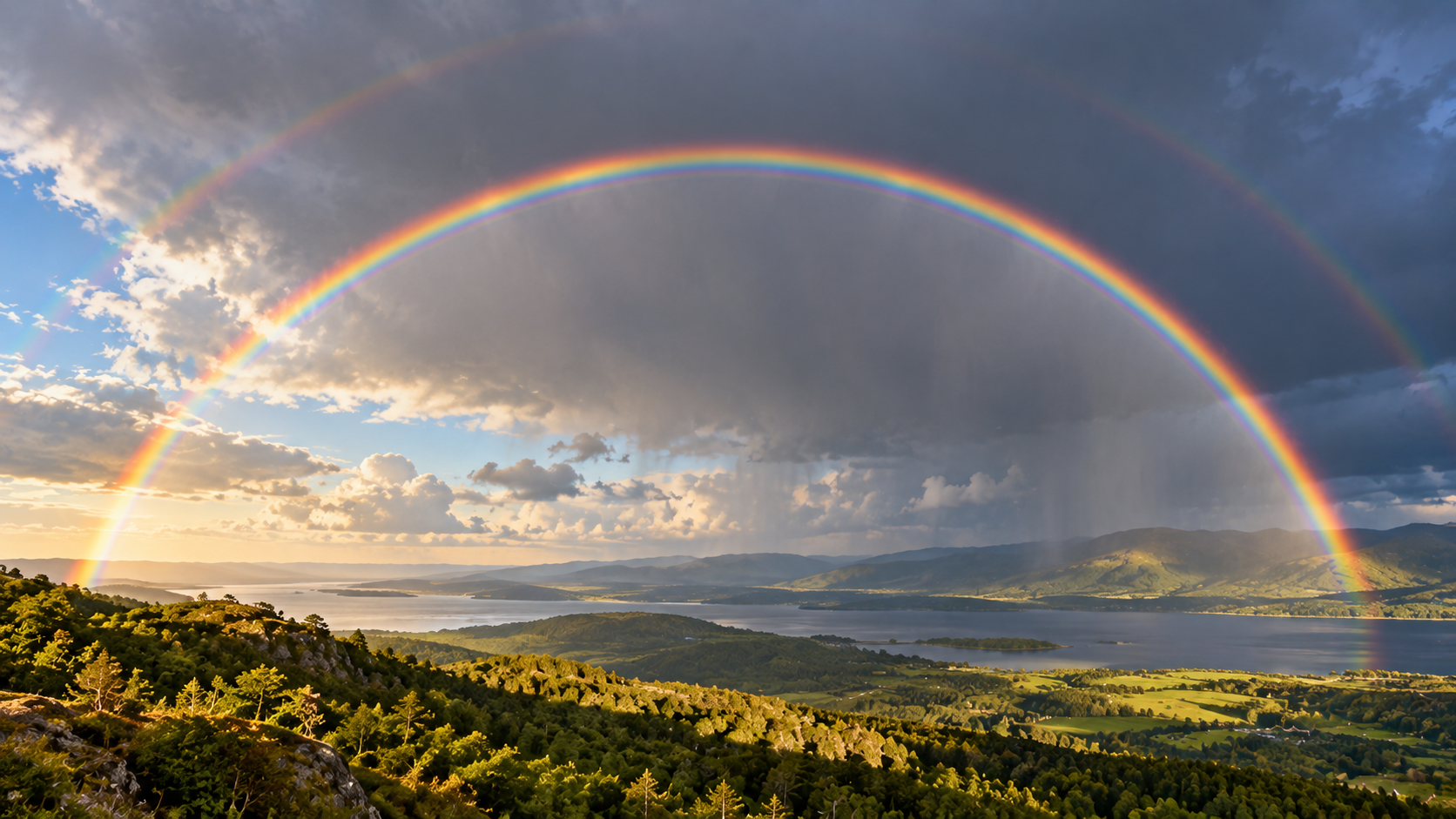
You can occasionally see a double rainbow, where a second, fainter rainbow appears outside the first one. The colors in the second rainbow appear in the opposite order because the light has reflected inside the water droplets twice instead of once.
There can even be other rainbow effects that look different from the familiar arc, depending on the size and shape of the water droplets and the position of the Sun.
A rainbow is a lesson about light
Rainbows are beautiful, but they also show us something important about the world.
Light that looks simple can contain many different colors. Water can change the direction of light. The position of the Sun affects what we see. And something as ordinary as a raindrop can act like a tiny optical instrument.
Once you understand that, you can start seeing other examples around you.
Why do soap bubbles sometimes show rainbow colors? Why does a CD shine with different colors? Why does a glass of water make objects behind it look slightly different?
They are all different ways that light can interact with materials.
Questions your child might ask next
Why does a rainbow sometimes have a second rainbow? A double rainbow happens when some of the light reflects inside the water droplets twice before reaching your eyes.
Can you touch a rainbow? No. A rainbow isn't an object sitting somewhere in the sky. It is light reaching your eyes from water droplets at particular angles.
Why does a rainbow disappear? If the Sun moves, the rain stops, or the water droplets are no longer in the right position, the rainbow disappears.
Can a rainbow appear at night? A rainbow needs a strong source of light. A bright full Moon can sometimes create a very faint rainbow-like effect called a moonbow.
Explore it together
The next time you see a rainbow, stop and notice where the Sun is. Then look at the rain or water droplets that are still in the air.
You can also make a rainbow yourself with a garden hose on a sunny day. Try changing your position and notice how the rainbow changes or disappears.
This is a good opportunity to ask your child a simple question: “Do you think the rainbow is in the same place for everyone who is looking at it?”
The answer may lead to an even more interesting conversation about light, perspective, and how our position affects what we see.
How Sapienta can help
A rainbow can be the beginning of a much bigger exploration. A child who wonders where the colors come from might become interested in light, reflections, shadows, rain, clouds, vision, or even how cameras work.
Sapienta helps parents follow those connections instead of treating each question as an isolated fact. It considers what a child has already explored, what interests them, and what level of explanation fits them, then suggests new ideas that can take their curiosity further.
You don't need to know which question comes next. You can start with a rainbow and let the next discovery grow from there.
Raise curious, knowledgeable kids.