

Earth is pulling on you
Earth is enormous, and its gravity reaches all around it. It pulls you toward the ground wherever you are.
That is why you can stand on the floor instead of floating around your room. It is why a ball thrown into the air eventually comes back down, and why rain falls from clouds instead of drifting away into space.
Gravity is always working, even when you aren't thinking about it.
You don't have to be touching the ground for Earth to pull on you. If you jump, gravity is still pulling you downward. It slows you down as you rise, stops you for a moment at the top of your jump, and then pulls you back toward the ground.
Why don't we fall toward the other side of Earth?
This is a strange thing to imagine.
If Earth is round, someone standing on the other side of the planet is technically upside down compared with you. So why don't they fall off?
Because “down” means toward the center of Earth.
Gravity pulls people and objects toward Earth's center from every direction. For you, that means down toward the ground beneath your feet. For someone on the other side of the planet, their “down” points in the opposite direction, but it still leads toward the center of Earth.
That's why everyone can stand on the ground, no matter where they are.
Does everything fall at the same speed?
Not exactly.
Air can make a big difference.
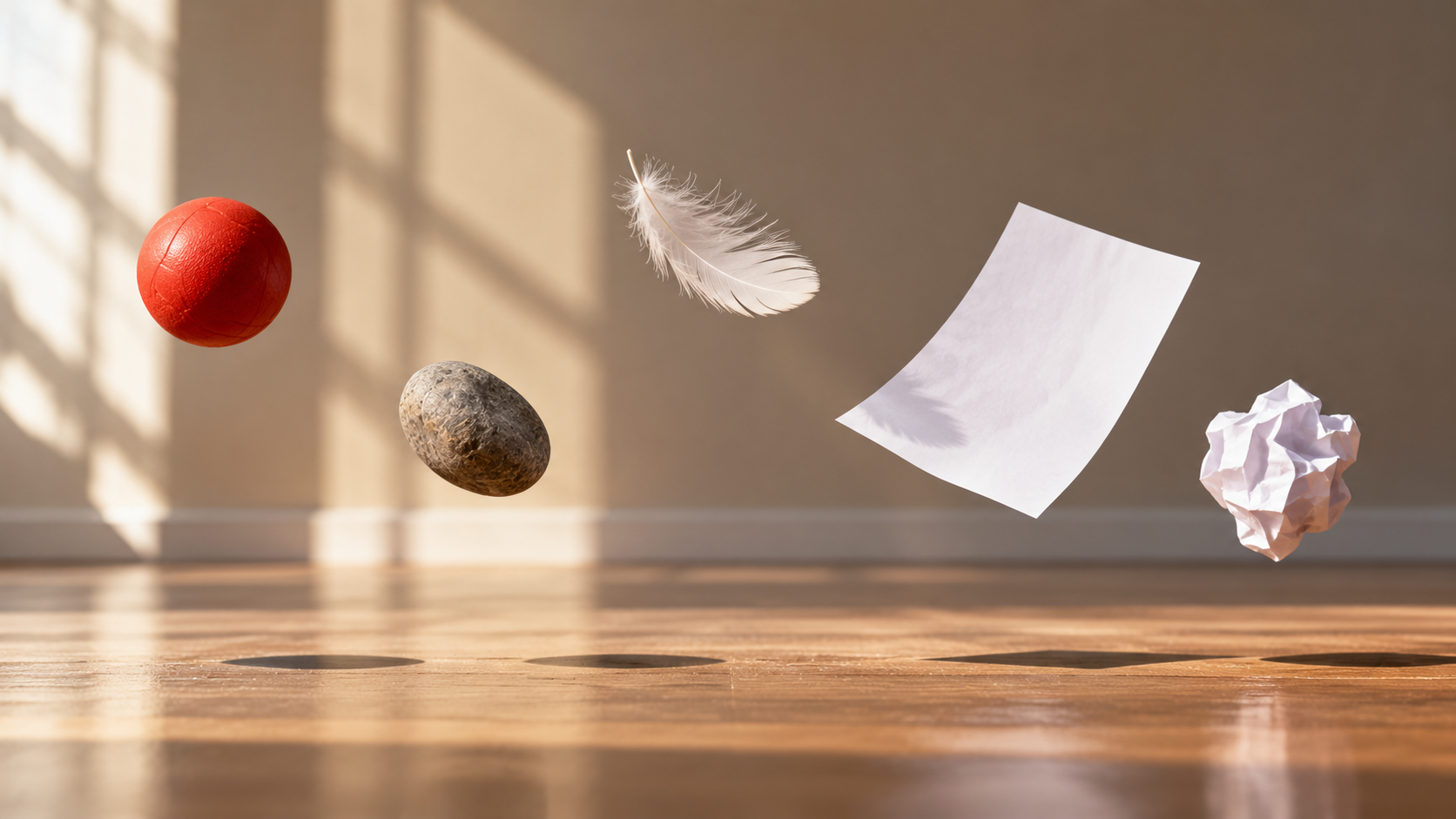
Drop a stone and a sheet of paper at the same time, and the stone will usually reach the ground first. It might seem as if gravity pulls the stone harder.
But try crumpling the paper into a small ball and dropping it again. Now the two objects may reach the ground much closer together.
The difference comes from the air pushing against the objects as they fall. The flat paper has a large surface for the air to push against, which slows it down.
If there were no air, objects would fall together under gravity regardless of their weight.
Astronauts have demonstrated this on the Moon, where there is almost no atmosphere. When a hammer and a feather were dropped together during the Apollo 15 mission, they reached the ground at the same time. (NASA)
Is gravity only found on Earth?
No. Gravity is everywhere.
The Sun has enormous gravity because it is so massive. Its gravity helps keep Earth and the other planets moving around it.
The Moon has gravity too, although it is much weaker than Earth's. That's why astronauts on the Moon could make much bigger jumps than they can on Earth.
You have gravity as well. So does a chair, a soccer ball, and even a pencil.
But these objects are so small compared with Earth that their gravitational pull is far too weak for you to notice.
The bigger an object is, the stronger its gravitational pull can be.
Gravity keeps the Moon around Earth
The Moon isn't simply hanging in the sky.
Earth's gravity is constantly pulling on it.
At the same time, the Moon is moving sideways through space. Instead of falling straight down to Earth, it keeps moving forward while gravity continually pulls it toward Earth.
The result is an orbit: the Moon keeps traveling around our planet.
The same basic idea helps explain why Earth travels around the Sun.
The Sun's enormous gravity pulls on Earth while Earth moves through space. Together, those two things keep Earth in its orbit.
What if there were no gravity?
Imagine jumping and never coming back down.
You might float through your bedroom, then out the window, and eventually into space.
Water would behave very differently too. Instead of staying in oceans, lakes, and rivers, it could drift away. The atmosphere around Earth would also be very different without gravity holding it close to the planet.
Gravity is one of the reasons Earth can be a place where life exists.
It keeps the atmosphere around us, holds oceans to the planet, keeps the Moon in orbit, and helps Earth stay in its path around the Sun.
Can you see gravity?
You can't see gravity itself, but you can experiment with its effects.
Drop a ball from different heights. Throw one straight up and watch what happens. Roll a ball down a slope and notice how its motion changes.
Try dropping two objects that have different weights but similar shapes. Then try objects with very different shapes, such as a crumpled piece of paper and a flat one.
You won't see gravity directly, but you'll see its effects everywhere.
Gravity is more than things falling
We often think of gravity as the thing that makes objects fall.
But gravity is doing much more than that.
It keeps us on Earth. It keeps the atmosphere around our planet. It helps hold the Moon in orbit and keeps the planets moving around the Sun. Gravity also plays a major role in forming stars, planets, and galaxies.
So the next time something falls from a table, you're seeing a tiny example of a force that helps organize the universe.
Questions your child might ask next
Why can astronauts float in space? Astronauts in orbit are still affected by Earth's gravity. They appear to float because they and their spacecraft are constantly falling around Earth together.
Why can you jump higher on the Moon? The Moon has much less mass than Earth, so its gravity is weaker.
Does gravity work underwater? Yes. Gravity pulls everything toward Earth's center, whether it is in the air, underwater, or underground.
What is a black hole? A black hole is an object with gravity so strong that even light cannot escape from it.
Explore it together
Take a ball outside and try dropping it from different heights. Then throw it upward and watch its path carefully.
Ask your child what they think is happening between the ball and the Earth. Is the Earth “reaching out” and pulling the ball? What would happen if the Earth were much smaller?
You don't need to solve every question. The goal is to notice that something as ordinary as dropping a ball is connected to the same force that keeps the Moon in the sky.
How Sapienta can help
A question about why things fall can quickly become a much bigger exploration.
What is gravity? Why does the Moon orbit Earth? Why do planets orbit the Sun? Why do astronauts float? What happens near a black hole?
Sapienta helps parents follow those connections and find the next idea that makes sense for their child. It takes their age, interests, and previous explorations into account, so a simple question can become the beginning of a much wider journey through science and space.
Raise curious, knowledgeable kids.