

Earth is tilted
Imagine a ball spinning around.
If you stood the ball perfectly straight and spun it, it would look quite different from a ball leaning to one side.
Earth is a little like that. It spins around an imaginary line that goes through its North Pole and South Pole. This line is called its axis, and Earth is tilted about 23 degrees.
The tilt stays pointed in roughly the same direction as Earth travels around the Sun.
That small tilt makes a huge difference.
What happens in summer?
Let's imagine it is summer in the Northern Hemisphere, where places such as the United States, Europe, and much of Asia are located.
At this time of year, the Northern Hemisphere is tilted toward the Sun.
That means sunlight hits the Northern Hemisphere more directly. The days are also longer, so there are more hours for the Sun to warm the ground.
More direct sunlight plus longer days means more heating.
That's why summer is warmer.
And what happens in winter?
About six months later, Earth has moved to the other side of the Sun.
Now the Northern Hemisphere is tilted away from the Sun.
The sunlight arrives at a lower angle, spreading its energy over a larger area. The days are also shorter, so there are fewer hours of sunlight to warm the ground.
That gives us winter.
At the same time, something interesting is happening in the Southern Hemisphere.
When it is winter in the north, it is summer in the south.
When people in Canada are wearing coats and watching snow fall, people in Australia may be enjoying their summer.
Earth doesn't have one season at a time. Different parts of the planet experience different seasons at the same time.
Why does the sunlight angle matter?
Here's a simple way to imagine it.
Shine a flashlight straight at a wall. The light makes a small, bright spot.
Now tilt the flashlight. The same light spreads over a larger area, so each part of that area gets less light.
Sunlight works in a similar way.
When the Sun is higher in the sky and its light reaches the ground more directly, the energy is concentrated over a smaller area.
When the Sun is lower in the sky, the same energy is spread over a larger area.
That's one reason a sunny summer day can feel much warmer than a winter day.
What about spring and autumn?
Spring and autumn are the seasons between summer and winter.
During these times, neither hemisphere is tilted strongly toward or away from the Sun.
Day and night are also closer to being the same length.
As Earth continues traveling around the Sun, the amount of sunlight reaching each hemisphere changes again, and the seasons gradually shift.
The whole cycle takes one year because Earth takes about 365 days to travel once around the Sun. (NASA)
Does the whole world have four seasons?
No.
The four-season pattern is most familiar in places farther from the equator. Near the equator, temperatures can stay fairly warm throughout the year, and the biggest changes may be in rainfall rather than temperature.
Near the North and South Poles, the differences can be much more extreme.
Some places in the far north can have almost 24 hours of daylight during part of the summer and almost 24 hours of darkness during part of the winter.
So there isn't one “summer” and one “winter” happening everywhere on Earth.
The seasons depend on where you are.
Can you notice the seasons changing?
You don't need a thermometer or a science experiment.
Pay attention to the Sun.
Where does it rise? Where does it set? How high does it get in the sky during the day?
Look at the length of the day. Notice when it starts getting dark.
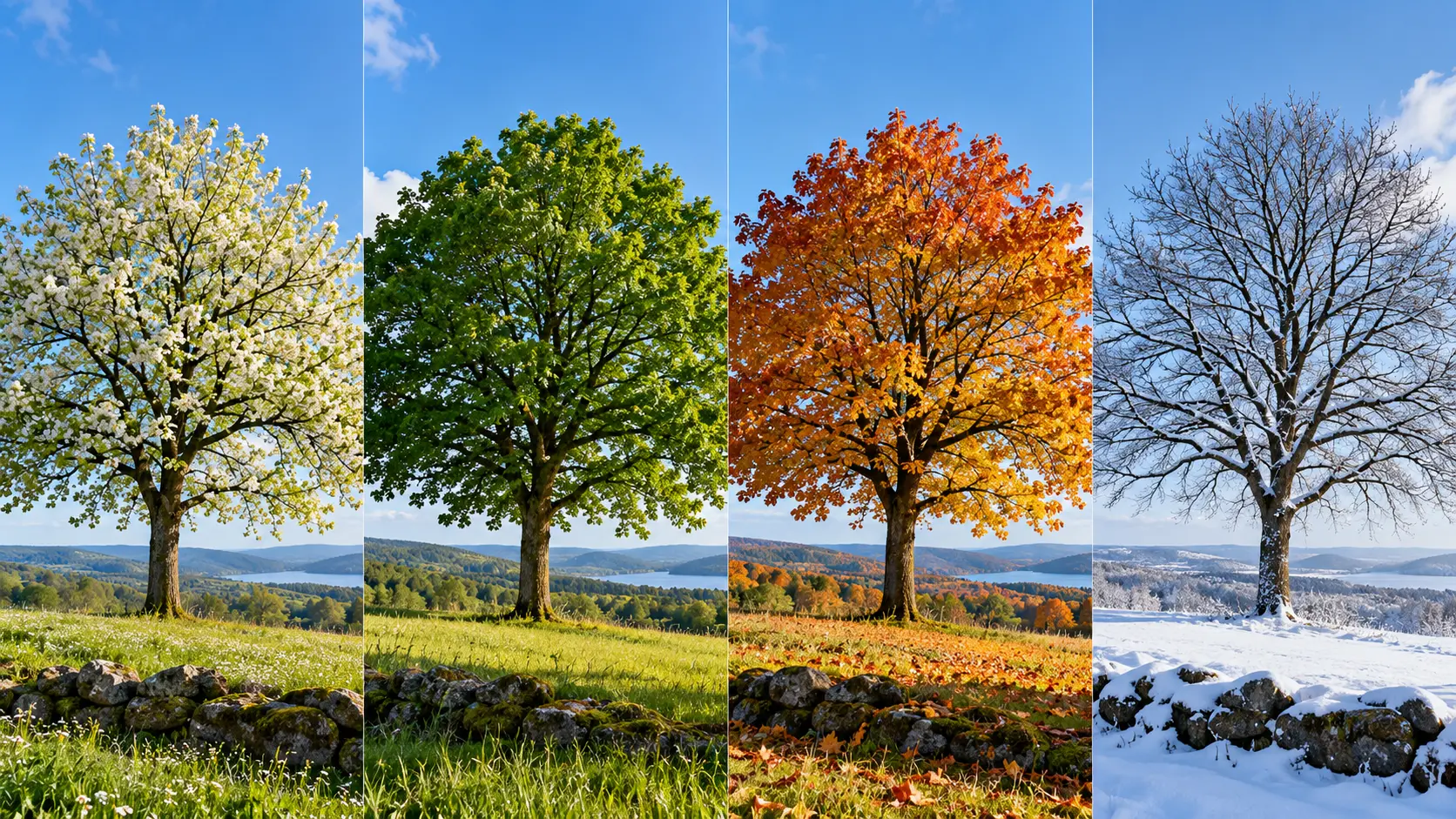
Look at trees and plants. Watch how animals behave. Notice how people change their clothes and activities.
You can even take a picture of the same view once every few weeks and compare the pictures later.
The changes are happening all around you.
What happens on other planets?
Earth isn't the only planet with seasons.
Mars has a tilt that is fairly similar to Earth's, so it also has seasons. But its year is much longer than ours, which means its seasons last much longer.
Other planets can have very different seasonal patterns because they have different tilts and different paths around the Sun.
So seasons aren't something that simply comes with being a planet.
They are the result of how a planet is tilted and how it moves around its star.
A small tilt changes a whole planet
It is easy to think of seasons as something simple: summer means hot, winter means cold.
But underneath that familiar pattern is a much bigger idea.
Earth is spinning. It is traveling around the Sun. It is tilted while it does both.
Those movements change how sunlight reaches different parts of our planet, and that changes our days, temperatures, plants, animals, and even the way people live.
A small tilt in a planet can shape an enormous part of life on it.
Questions your child might ask next
Why are summer days longer? When your part of Earth is tilted toward the Sun, it spends more of the day facing sunlight.
Why is it summer in Australia when it is winter in the United States? The Northern and Southern Hemispheres tilt toward the Sun at opposite times of the year.
Does Earth get closer to the Sun in summer? Earth's distance from the Sun changes a little during the year, but that is not what causes our seasons.
Do other planets have seasons? Some do. Their seasons depend on things such as how much they are tilted and how they travel around their star.
Explore it together
Choose a sunny spot outside and visit it at different times of the year.
Notice where the Sun is in the sky. How long does the sunlight reach the spot? Is the area warm or cool?
You can also use a ball and a flashlight to make a simple model of Earth and the Sun. Tilt the ball slightly and move it around the flashlight. Watch how the light falls on different parts of the ball.
You don't need to get every detail right. The goal is to see the basic idea: Earth's tilt changes the way sunlight reaches us during the year.
How Sapienta can help
A question about seasons can lead somewhere much bigger.
Why does Earth have a tilted axis? Why are the poles so cold? Why is it always warm in some places? Why do some animals migrate when the seasons change? How do plants know when spring has arrived?
Sapienta helps parents follow those connections. It recommends ideas based on a child's age, interests, and what they have already explored, so one question can naturally lead to the next.
You don't need to plan an entire journey through science yourself. Start with the question your child is asking today, and see where it takes you.
Raise curious, knowledgeable kids.