

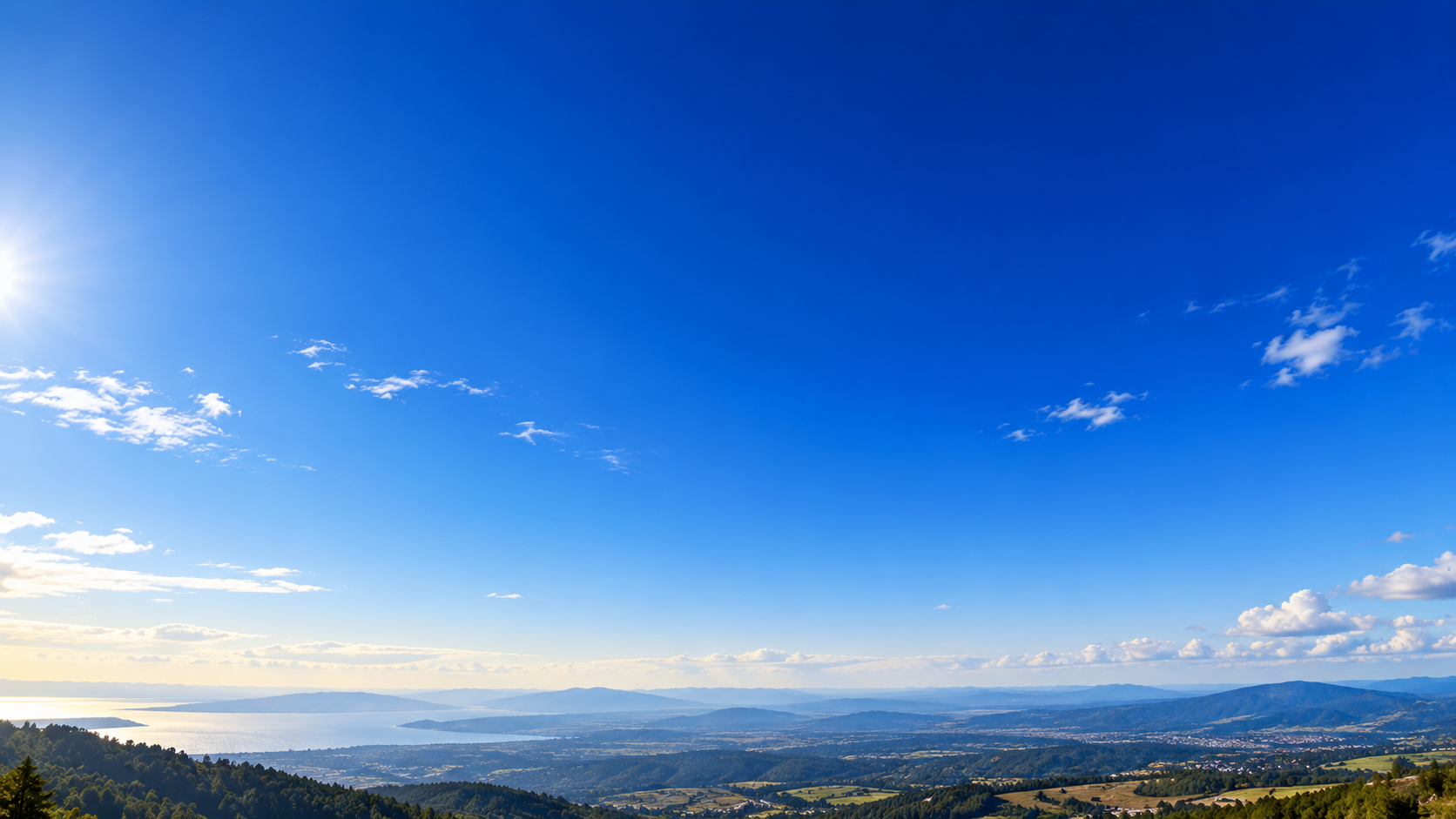
Sunlight contains many colors
Sunlight may look like one color, but it is actually made up of many colors mixed together.
You can see this when you look at a rainbow. Red, orange, yellow, green, blue, and violet are all part of the light that comes from the Sun.
When sunlight travels through space, it mostly moves in a straight line. But when it reaches Earth's atmosphere, something interesting happens.
The atmosphere is the layer of air that surrounds our planet. It contains tiny bits of matter, including very small particles of gases such as oxygen and nitrogen.
When sunlight bumps into these tiny particles, some of the light changes direction. Scientists call this scattering.
Blue light gets scattered much more easily than red light.
So blue light gets sent in many different directions across the sky. Some of that blue light eventually reaches your eyes.
That is why, when you look up in almost any direction, you see blue.
Why don't we see all the colors?
We do.
The other colors of sunlight are still there. They simply don't get scattered through the air as much as blue light does.
Think of sunlight as a mixture of many colors traveling together. When they pass through the atmosphere, the blue part gets bounced around much more.
Your eyes receive blue light coming from many different parts of the sky, so the sky looks blue.
There is one small puzzle here. Violet light gets scattered even more than blue light. So why isn't the sky violet?
Our eyes are much better at seeing blue than violet. Some violet light is also absorbed by the atmosphere. Because of this, blue is the color we notice most. (NASA)
Then why is the sunset red?
This is one of the best parts of the story.
When the Sun is high in the sky, sunlight doesn't have to travel through very much air before it reaches you.
At sunset, the Sun is low near the horizon. Its light has to travel through a much longer path through the atmosphere.
As the light travels farther, more of the blue light gets scattered away.
That leaves more red, orange, and yellow light traveling toward your eyes.
That's why the sky near the setting Sun can turn orange, pink, or red.
Dust, smoke, and other tiny particles in the air can change the colors even more. This is one reason why some sunsets are much more colorful than others. (NOAA)
So the blue sky during the day and the red sky at sunset are actually caused by the same basic idea.
Can you see it happening?
You don't need any special equipment.
Go outside on a clear day and look at the sky. Look straight above you, then look toward the horizon. Does the blue look exactly the same?
Then watch the sky around sunset. Notice how the color changes as the Sun gets lower.
You can also look at the sky on different days. Sometimes it looks deep blue. Sometimes it looks pale blue or almost white.
Why?
Now you have another question to investigate.
What would the sky look like somewhere else?
Here's a surprising idea: the sky doesn't have to be blue.
Earth has the kind of atmosphere that makes its sky look blue. Other planets have different atmospheres, so their skies can look very different.
Mars, for example, has a thin atmosphere filled with tiny dust particles. During the day, its sky often looks yellowish or reddish rather than blue. Near sunset, something even stranger happens: the sky close to the Sun can look blue. (NASA)
That means the color of a planet's sky can tell scientists something about what is in the air around that planet.
A simple question about the color of the sky has taken us from Earth to other worlds.
A question can lead somewhere unexpected
Children often ask questions about things they see every day.
Why is the sky blue?
Why does the Moon change shape?
Why do shadows move?
Why do leaves change color?
These questions may sound simple, but they can lead to much bigger ideas.
The important thing is not to memorize the word scattering. It's to understand the basic idea: sunlight contains many colors, and Earth's air sends some of those colors in different directions more than others. Blue gets scattered around the sky, so that's the color we see most.
Once that makes sense, the more complicated science can come later.
Questions your child might ask next
Why is the sunset red? Because sunlight travels through more air when the Sun is near the horizon, and much of the blue light gets scattered away.
Why are clouds white? Clouds contain much larger water droplets and ice crystals that scatter many colors of light together, making them look white.
Why does the sky sometimes look gray? Clouds, moisture, dust, and other things in the air can change how much light reaches your eyes.
Would the sky look blue on another planet? Not necessarily. It depends on what that planet's atmosphere is like.
Explore it together
The next time your child asks why the sky is blue, don't stop at the answer.
Ask: “Why do you think the sunset is a different color?”
Then watch one together.
Sometimes the best science lesson is already above your heads.
How Sapienta can help
One question rarely stays just one question.
A child who wonders why the sky is blue might become curious about sunsets, rainbows, clouds, light, the atmosphere, or what the sky looks like on other planets. One idea can lead naturally to another.
That's the kind of curiosity Sapienta is designed to nurture. Sapienta helps parents discover what their child might be ready to explore next, taking into account their interests, age, and what they've already explored.
You don't need to plan the entire journey yourself. Start with the question your child is asking today, and let curiosity lead to the next one.
Raise curious, knowledgeable kids.