
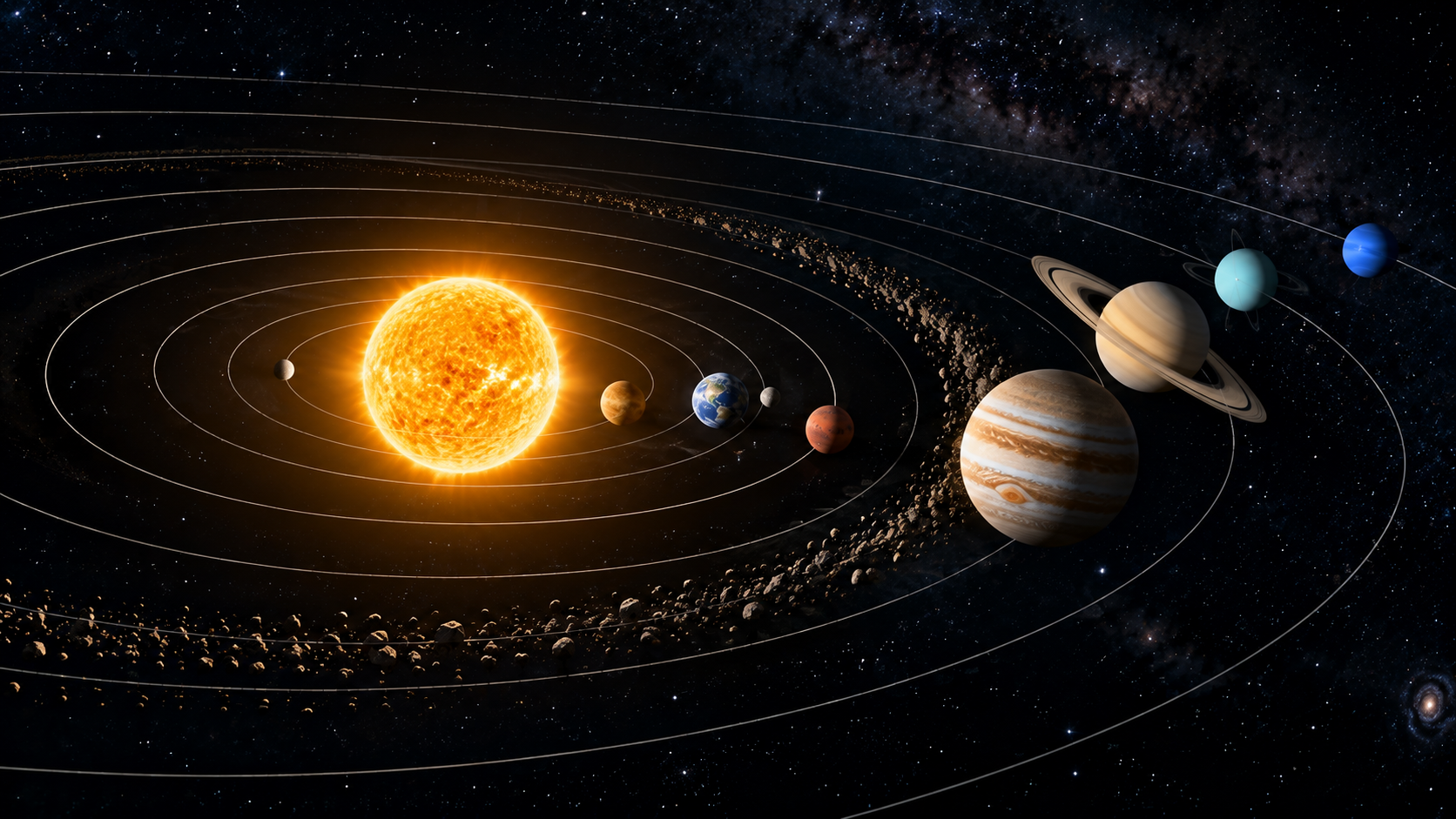
The Sun is pulling on the planets
Gravity is the force that pulls objects toward one another. You can see it whenever you drop a ball and watch it fall toward Earth.
The Sun has much more mass than any planet in our solar system, so its gravitational pull is enormous. It reaches far out into space, affecting the planets, moons, asteroids, comets, and other objects that make up our solar system.
Earth is constantly being pulled toward the Sun. If Earth were not moving, it would fall toward the Sun.
But Earth is moving, and that changes everything.
Imagine throwing a ball
If you throw a ball across a field, it doesn't travel in a perfectly straight line. Earth's gravity pulls it downward, so its path curves toward the ground.
Now imagine throwing the ball much faster. It would travel farther before gravity brought it down.
The planets are doing something similar, although on a much larger scale. They are moving forward through space while the Sun's gravity continually pulls them toward it. Instead of traveling in a straight line, their paths curve around the Sun.
You can think of an orbit as the result of these two things happening at once. The planet is moving forward, while gravity keeps changing the direction of that motion.
The planet is always being pulled toward the Sun, but because it is also moving forward, it keeps missing the Sun.
Why doesn't Earth eventually fall into the Sun?
This is a natural question because the Sun's gravity never stops pulling on Earth.
The important thing to understand is that an orbit isn't a situation where gravity and motion cancel each other out and nothing happens. Gravity is constantly changing the direction in which Earth is moving. Instead of allowing Earth to continue in a straight line, it bends Earth's path into a huge curve around the Sun.
If the Sun's gravity suddenly disappeared, Earth would no longer follow that curved path. It would continue moving through space in roughly the direction it was already traveling.
If Earth somehow lost most of its forward motion, the Sun's gravity would pull it much closer to the Sun.
Our orbit exists because Earth has both motion and gravity acting on it at the same time. NASA's explanation of planetary motion describes this relationship between forward motion and the Sun's gravitational pull.
The planets weren't placed into their orbits
There is another interesting part of the story. The planets have been orbiting the Sun for billions of years, but they weren't created separately and then somehow placed into their current paths.
The solar system formed about 4.6 billion years ago from a huge cloud of gas and dust. As gravity pulled the cloud together, it began spinning faster and flattened into a disk. Most of the material collected in the center and formed the Sun, while much of the remaining material gradually came together to form the planets and other objects.
Because the original cloud was spinning, the material that became the planets was already moving around the young Sun. The planets inherited much of that motion, which helps explain why their orbits today are arranged in such a similar pattern. NASA describes the formation of the solar system from this enormous spinning cloud of gas and dust.
So the planets' journeys around the Sun are connected to the very beginning of the solar system.
The planets don't all travel at the same speed
Earth takes about one year to complete an orbit around the Sun. Mercury, which is much closer to the Sun, takes only about 88 days. Neptune, the most distant planet in our solar system, takes about 165 Earth years.
There are two reasons for this difference. A planet farther from the Sun has a much larger orbit, so it has much farther to travel. Its orbit also moves through a region where the Sun's gravitational pull is weaker.
The planets don't move at exactly the same speed throughout their orbits, either. Their paths are slightly stretched rather than being perfect circles, so a planet moves somewhat faster when it is closer to the Sun and somewhat slower when it is farther away.
Astronomers have described these patterns with mathematical rules known as Kepler's laws of planetary motion. We don't need the mathematics to understand the basic idea: the size and shape of a planet's orbit are connected to how quickly it travels and how long it takes to go around the Sun. NASA's overview of Kepler's laws explains these relationships.
Why are the planets' orbits so similar?
If you could look down on the solar system from far above the Sun, you'd notice that the planets don't orbit in completely random directions. Their paths are arranged in nearly the same broad, flat region of space.
That also comes from the way the solar system formed.
The original cloud of gas and dust flattened into a spinning disk as it collapsed under gravity. The planets formed from material inside that disk, so their orbits remained roughly within the same plane.
In a way, the arrangement of the planets still carries a memory of the cloud from which they formed.
Scientists have found that this isn't unique to our solar system. When they observe young stars, they can sometimes see disks of gas and dust around them, and astronomers have discovered thousands of planets orbiting other stars as well.
What would happen if Earth stopped moving?
Imagine that Earth suddenly stopped moving around the Sun while the Sun's gravity continued working normally. Earth would no longer have the forward motion that helps keep it in orbit, so it would begin falling toward the Sun.
Now imagine the opposite. Suppose the Sun's gravity suddenly disappeared while Earth kept moving at its current speed. Earth would no longer curve around the Sun. It would continue traveling through space in a roughly straight line.
Neither of these things happens in reality. Earth's motion and the Sun's gravity are continuously interacting, which is why Earth can remain in a stable orbit for billions of years.
This same idea helps explain the Moon's orbit around Earth and the paths of artificial satellites around planets. Gravity doesn't stop objects from moving. It changes the way they move.
You are moving through space right now
There is something strange about all of this that is worth thinking about with a child.
You are standing on Earth, and it feels completely still. But Earth is spinning. At the same time, it is traveling around the Sun. The Sun is moving through our galaxy, and the Milky Way is moving through space.
We don't notice most of this movement because we are moving along with everything around us.
The night sky can therefore look peaceful and motionless even though almost everything you see is moving. The Moon is moving around Earth, Earth is moving around the Sun, and the Sun itself is traveling through the Milky Way.
Space only looks still because the distances are so enormous.
Questions your child might ask next
Why Does the Moon Go Around Earth? The Moon is pulled toward Earth by gravity while its forward motion carries it through space, producing an orbit around our planet.
Why Does the Moon Change Shape? The Moon itself stays round. As it moves around Earth, we see different amounts of the side illuminated by the Sun.
Why Do Stars Shine? Stars produce enormous amounts of energy in their hot centers, and some of that energy reaches us as light.
Why Do Things Fall Down? Earth's gravity pulls objects toward its center. Gravity is the same force that helps keep the Moon around Earth and Earth around the Sun.
Explore it together
Take a ball and place a small sticker on it to represent Earth. Then slowly move the ball around a lamp or another light source to represent Earth's journey around the Sun.
The model won't perfectly reproduce the real solar system, but it can help you think about something important: Earth is always moving while the Sun's gravity keeps bending its path.
You can then ask your child to imagine the opposite. What would happen if Earth suddenly stopped moving? What if the Sun disappeared? What if Earth were twice as far from the Sun?
Making predictions is part of how we begin to think like scientists, even when we don't know the answer yet.
How Sapienta can help
A question about why planets orbit the Sun can lead naturally to gravity, Earth's movement, the seasons, the Moon's orbit, the formation of the solar system, and eventually to the discovery of planets around other stars.
Sapienta helps parents follow those connections. It considers what a child has already explored, along with their age and interests, and helps find another idea that builds naturally from what they already know.
You don't need to plan the entire path. Start with the question your child is asking today, and let curiosity lead to the next one.
Raise curious, knowledgeable kids.