
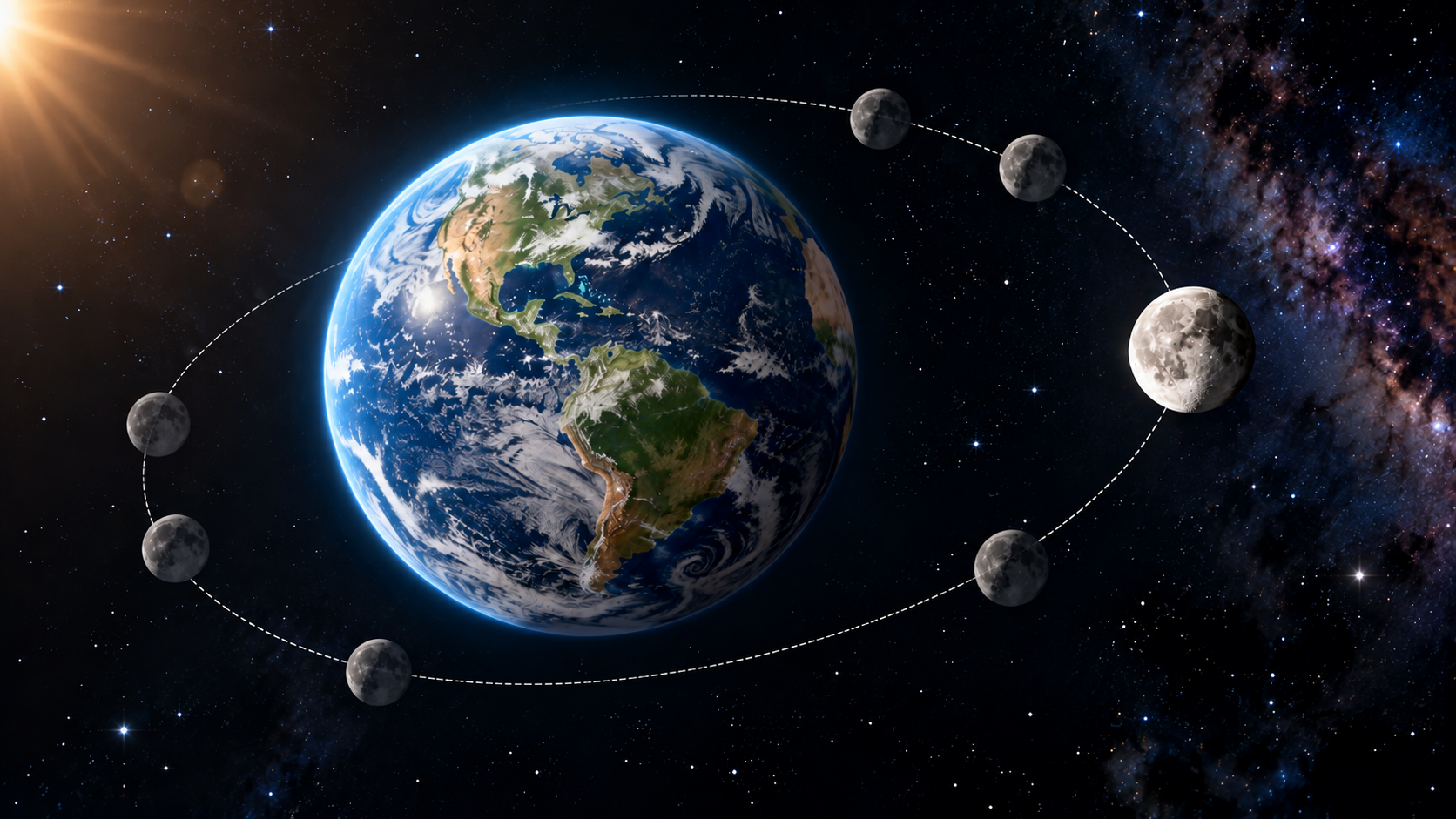
Earth is pulling on the Moon
Gravity is the force that pulls objects toward one another.
You can see gravity working everywhere around you. If you drop a ball, Earth pulls it downward. If you jump, gravity brings you back to the ground. Earth also has gravity, so it pulls on the Moon.
The Moon is quite far away, but Earth's gravity still reaches it.
So why doesn't the Moon simply fall toward Earth?
Because the Moon is moving.
The Moon is always falling, but it keeps missing Earth
This sounds strange, but it is one of the best ways to understand an orbit.
Imagine throwing a ball forward. It moves forward, but gravity also pulls it downward, so its path curves toward the ground.
Now imagine throwing it much faster. It would travel farther before reaching the ground.
If you could throw it fast enough, and there were no mountains or air getting in the way, the surface of Earth would curve away beneath it as quickly as the ball was falling toward Earth.
The ball would keep falling toward Earth, but it would keep missing the ground.
That is roughly what is happening with the Moon.
The Moon is being pulled toward Earth by gravity, but it is also moving sideways through space. Instead of crashing into Earth, it continually curves around it.
This curved path is called an orbit.
The Moon isn't sitting still
It is easy to imagine the Moon as a stationary object while Earth spins underneath it. In reality, the Moon is moving through space too.
The Moon travels around Earth once in about 27 days. At the same time, Earth is rotating and traveling around the Sun.
So when you look at the Moon tonight, you are looking at something that is moving incredibly quickly, even though it appears calm and almost motionless from the ground.
Space can be deceptive that way. Something can look still simply because it is very far away.
Why doesn't the Moon fly away?
Now imagine the opposite situation.
Suppose the Moon were moving much faster. Its forward motion would be strong enough to carry it farther away from Earth, and it could eventually escape Earth's gravity.
If the Moon were moving much more slowly, Earth's gravity would pull it closer and its orbit would change.
The Moon's actual motion and Earth's gravity work together in a way that keeps the Moon in a long-lasting orbit.
The same basic idea explains why artificial satellites can orbit Earth. A satellite is moving forward while Earth's gravity continually bends its path around the planet.
Earth is doing the same thing around the Sun
The Moon isn't the only object in an orbit.
Earth is traveling around the Sun, and the other planets are doing the same thing. The Sun's gravity pulls on Earth, while Earth's motion carries it forward.
So Earth is also continually falling toward something while moving sideways enough to keep missing it.
This gives us a useful way to think about the solar system. The planets aren't being held up by invisible strings, and they aren't sitting on some kind of track. Gravity is constantly changing the direction of their motion.
The Sun's gravity keeps the planets in their orbits, while the planets' motion keeps them from simply falling into the Sun. NASA describes this combination of gravity and motion as what keeps planets in orbit.
Why doesn't everything in space crash into everything else?
Space is full of objects moving under the influence of gravity, but that doesn't mean they all crash together.
The path an object follows depends on its speed, direction, distance, and the gravity of other objects around it.
A planet can orbit a star. A moon can orbit a planet. A spacecraft can orbit a planet or travel onward into space. Some objects follow very stretched-out paths and travel far away before returning.
There are many different kinds of orbits.
The important idea is that an orbit is not a place where gravity disappears. Gravity is actually what helps create the orbit.
The Moon's orbit is not a perfect circle
If you could watch the Moon's path from far above Earth, you would see that it isn't a perfect circle. Like the orbits of planets, the Moon's path is slightly oval-shaped.
That means the Moon is sometimes a little closer to Earth and sometimes a little farther away.
The difference isn't dramatic enough to make the Moon suddenly look enormous or tiny, but it is another reminder that the paths of objects in space are more complicated than the simple circles we often draw in pictures.
You can make an orbit with a ball
There is a simple way to demonstrate the basic idea of an orbit.
Take a ball and tie it to a string. Hold the other end and swing the ball around you.
The string pulls the ball toward your hand while the ball's motion carries it forward. Together, those two effects make the ball travel in a circle.
This isn't exactly how the Moon works because there is no physical string connecting Earth and the Moon. The string is simply a useful model for imagining what gravity does.
You can make the model even more interesting by asking what would happen if the ball moved faster or slower.
Then ask your child: What do you think would happen if the string suddenly disappeared?
The ball would fly away in a straight line.
That is similar to what would happen to the Moon if Earth's gravity suddenly disappeared. Its existing motion would carry it away rather than keeping it in an orbit.
The Moon's orbit affects what we see
The Moon's journey around Earth also explains something you can observe from your own backyard: the Moon's phases.
As the Moon moves around Earth, we see different amounts of the side that is illuminated by the Sun. That's why the Moon can appear as a thin crescent, a half Moon, a full Moon, and many shapes in between.
So when you watch the Moon change shape over several weeks, you are actually watching the result of its movement through space.
A simple change in appearance is evidence that something enormous is happening far above us.
Questions your child might ask next
Why Do Planets Go Around the Sun? The planets are pulled by the Sun's gravity while their forward motion keeps them traveling around it instead of falling directly into the Sun.
Why Does the Moon Change Shape? The Moon doesn't actually change shape. As it travels around Earth, we see different amounts of its sunlit side.
Why Do Things Fall Down? Earth's gravity pulls objects toward its center. The same force that makes a dropped ball fall also helps keep the Moon in orbit.
Why Do Stars Shine? Stars produce enormous amounts of energy in their hot centers, and some of that energy eventually reaches us as light.
Explore it together
Find the Moon in the sky and watch it for several nights. Does it appear in exactly the same place at the same time each night?
You can also draw Earth, the Moon, and the Sun on a piece of paper and show the Moon in several positions around Earth. Ask your child to predict what the Moon would look like from Earth in each position.
Then ask a bigger question: If the Moon is moving around Earth, and Earth is moving around the Sun, what is the Sun moving around?
That question takes you from the Moon to the solar system, the Milky Way, and eventually to the enormous scale of the universe.
How Sapienta can help
A question about the Moon's orbit can lead naturally to gravity, the phases of the Moon, Earth's journey around the Sun, satellites, planets, and the much bigger question of how everything in space moves.
Sapienta helps parents follow those connections. It considers what a child has already explored, along with their age and interests, and helps uncover another idea that builds naturally from what they already know.
You don't need to plan the whole journey yourself. Start with something your child notices in the sky, and let the next question lead somewhere new.
Raise curious, knowledgeable kids.