

The Moon does not make its own light
The Moon looks bright because sunlight shines on it. The Moon does not produce its own light, just as a ball does not suddenly start glowing when you shine a flashlight on it.
The Sun is lighting up the Moon all the time. At any moment, roughly half of the Moon is facing the Sun and receiving sunlight, while the other half is facing away from the Sun and is dark.
So why don't we always see a full Moon?
Because the Moon is moving around Earth.
As it travels around our planet, our view of its sunlit half changes. Sometimes most of the bright side is facing us. Sometimes only a small part is facing us. Sometimes the bright side is mostly facing away from us, so the Moon looks almost completely dark.
Imagine a ball and a flashlight
There is a simple way to picture this.
Imagine you are standing in a dark room holding a ball. Someone across the room shines a flashlight at it. The side of the ball facing the flashlight is bright, while the other side is dark.
Now walk around the ball.
The ball hasn't changed. The flashlight hasn't changed either. But from your new position, you can see a different amount of its bright side.
That is basically what happens with the Moon.
The Sun is the flashlight, the Moon is the ball, and Earth is where you are standing.
The Moon follows a repeating pattern
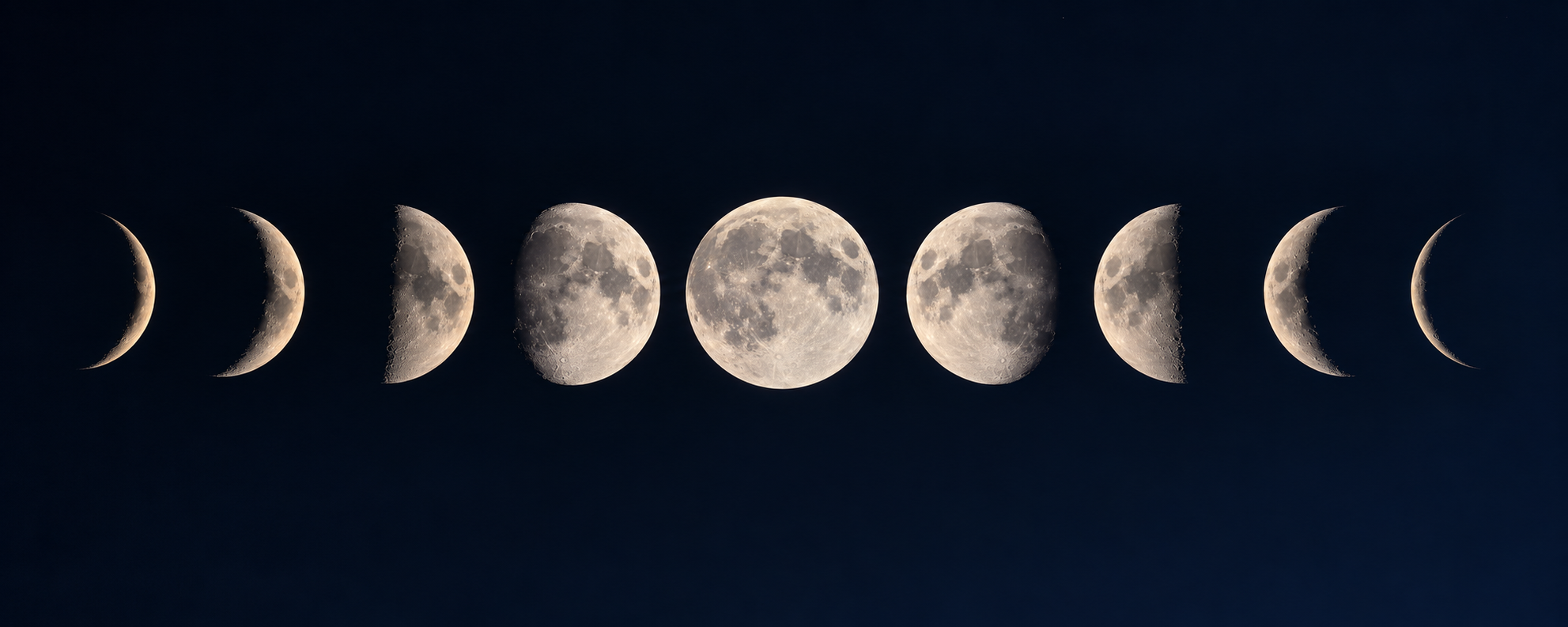
As the Moon travels around Earth, we see a familiar sequence of phases.
When the Moon is between Earth and the Sun, the side facing Earth is mostly dark. This is called a new Moon.
Then a thin crescent of sunlight begins to appear. The bright part grows over the next several days until we see about half of the Moon. After that, more and more of the sunlit side becomes visible until we reach a full Moon, when the side facing Earth is almost completely illuminated.
Then the pattern reverses. The bright part becomes smaller again, changing from a full Moon to a half Moon, then to a thin crescent, and eventually back to a new Moon.
The whole cycle takes about 29.5 days from one new Moon to the next.
You may hear people use words such as waxing and waning. Waxing means the bright part we can see is growing, while waning means it is getting smaller.
Is Earth's shadow causing the Moon to change?
This is a common idea, but usually the answer is no.
The Moon's phases are not caused by Earth's shadow. The Moon is always half lit by the Sun, and we see different amounts of that bright half as the Moon moves around Earth.
Earth's shadow does fall across the Moon during a lunar eclipse, but that is a special event. It is not what causes the normal monthly pattern of Moon phases.
This is an interesting distinction to notice. A crescent Moon may look as if part of the Moon has been covered by a shadow, but the dark part is actually the part of the Moon that is experiencing nighttime.
Why does the Moon sometimes disappear?
During a new Moon, the Moon is still in the sky. It hasn't gone anywhere.
The problem is that the side of the Moon facing Earth is mostly the dark side at that point in its journey around Earth. The bright side is facing the Sun, so there isn't much sunlight reflecting toward us.
The Moon can also be difficult to see when it is close to the Sun in the daytime sky.
This means that a "missing" Moon is really a Moon that we aren't able to see clearly from our position.
Do we always see the same side of the Moon?
Yes, almost exactly.
The Moon rotates as it travels around Earth, but it rotates at exactly the right rate to keep the same side facing us. That is why photographs of the Moon from Earth always show the same familiar side.
This can be surprising because it means the Moon really is spinning. If it didn't rotate at all while going around Earth, we would eventually see different sides of it.
There isn't a permanent "dark side of the Moon," either. The far side receives sunlight too. It simply isn't the side we normally see from Earth.
You can watch the pattern yourself
The Moon is one of the easiest things in space to observe without any special equipment.
Choose a night when you can see it clearly and make a quick drawing of its shape. Do the same thing every few days. After a few weeks, you'll begin to notice the pattern.
Pay attention to more than just the shape. Where is the Moon in the sky? What time do you see it? Is it visible in the evening, late at night, or even during the day?
You can eventually make a prediction: What do you think the Moon will look like a few nights from now?
That turns simply looking at the Moon into a small science experiment.
The Moon connects to bigger questions
Once a child understands why the Moon changes shape, several other questions become easier to explore.
Why does the Moon orbit Earth? Why does Earth orbit the Sun? Why don't the planets fly away? What causes a lunar eclipse? Why does the Moon sometimes appear during the day? Why does the Moon's gravity affect Earth's oceans?
One simple observation in the night sky can open the door to gravity, motion, light, time, calendars, tides, and the history of space exploration.
The Moon is a good example of how science often begins. You notice something ordinary, realize you don't quite understand it, and start asking better questions.
Questions your child might ask next
Why does the Moon orbit Earth? Earth's gravity pulls on the Moon, keeping it traveling around our planet rather than flying away into space.
Why can we sometimes see the Moon during the day? The Moon is above our horizon during part of the daytime on many days. Whether we notice it depends on its position and how bright its current phase is.
Why is a full Moon so bright? During a full Moon, we can see almost all of the Moon's sunlit side facing Earth, so a large amount of reflected sunlight reaches our eyes.
Does the Moon really change shape? No. Its shape stays nearly the same. What changes is the amount of its sunlit side that we can see.
Explore it together
Try making a model with a ball and a flashlight in a dark room. Let one person hold the flashlight while another person slowly moves around the ball.
Watch how the bright part of the ball looks different from different positions. Then compare what you see with the Moon outside.
You can also keep a simple Moon diary for a month. Draw what you see every few nights and see if you can predict what comes next.
How Sapienta can help
A child's question about the Moon can easily lead somewhere unexpected. Understanding Moon phases might lead to questions about gravity, eclipses, planets, tides, calendars, or how humans first explored the Moon.
Sapienta helps parents follow those connections. It keeps track of what a child has already explored and uses their interests and level of understanding to suggest what could be worth discovering next.
You don't need to plan a curriculum or know which question should come next. Start with something your child notices, and let curiosity lead from there.
Raise curious, knowledgeable kids.