
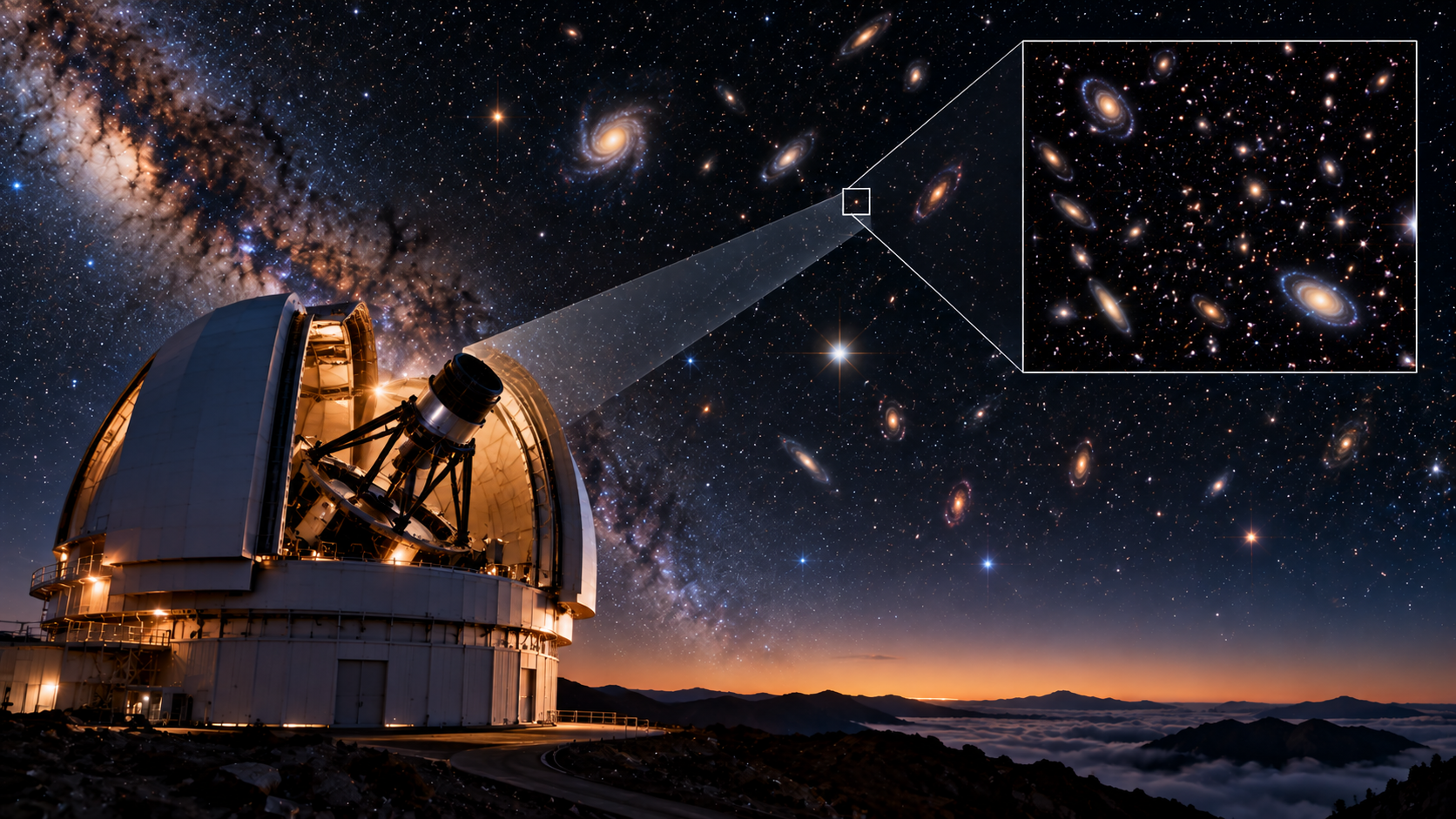
Light carries information across space
The most important clue astronomers have is light.
Light travels through space at an incredible speed, carrying information from the objects that produced it or reflected it. When that light reaches Earth, scientists can study it in great detail.
The light from a star can tell us what elements are present in its atmosphere. Changes in a star's light can reveal that something is moving around it. Light from a galaxy can tell scientists how fast that galaxy is moving and how far away it is.
This is why stars can tell us so much even though they are unimaginably far away.
Astronomers aren't simply looking at tiny dots. They are examining the information carried by the light from those dots.
Telescopes help us see what our eyes cannot
A telescope is much more than a device that makes distant objects look bigger.
Large telescopes collect far more light than the human eye can. This allows astronomers to see objects that are extremely faint, as well as details that would otherwise be impossible to notice.
Some telescopes are placed on Earth, while others are sent into space. Space telescopes can observe wavelengths of light that Earth's atmosphere blocks or distorts, and they can avoid some of the problems caused by looking through the atmosphere.
The James Webb Space Telescope, for example, observes mainly infrared light. This allows scientists to study very distant galaxies, stars forming inside clouds of gas and dust, and planets around other stars. NASA explains how different kinds of telescopes allow astronomers to study different parts of the universe.
There is more than one kind of light
When you hear the word "light," you might think only about the colors your eyes can see.
But visible light is just one small part of something called the electromagnetic spectrum. It also includes radio waves, microwaves, infrared light, ultraviolet light, X-rays, and gamma rays.
Our eyes can detect only a narrow range of these wavelengths.
Different kinds of light can reveal different things. Infrared observations can help astronomers see through some clouds of dust and study cooler objects. X-rays can reveal extremely hot regions around objects such as black holes and neutron stars. Radio waves can reveal signals from distant galaxies and clouds of gas.
It's a little like investigating a house by looking at it through different kinds of cameras. Each one can reveal something the others might miss.
Scientists can learn what stars are made of
This may seem almost impossible.
How can anyone know what a star is made of when nobody can take a sample from it?
The answer is hidden in starlight.
When light from a star passes through a spectroscope, scientists can spread it into a spectrum, a little like separating sunlight into the colors of a rainbow. Dark or bright lines appear at particular places in the spectrum.
Those lines are clues about the elements in the star.
Different elements interact with light in specific ways, producing recognizable patterns. By studying those patterns, astronomers can work out which elements are present.
So when scientists say that a star contains hydrogen, helium, or other elements, they aren't guessing based on how the star looks. They have evidence contained in its light.
We can even find planets around distant stars
Planets are much harder to see than stars because they are smaller and don't usually produce their own visible light.
So how can astronomers discover planets that are hundreds or thousands of light-years away?
One method is to watch a star carefully and look for a tiny, regular change in its brightness.
If a planet passes between the star and Earth, it can block a very small amount of the star's light. The star appears to become slightly dimmer, then returns to its usual brightness.
If this happens repeatedly at regular intervals, it can be evidence that a planet is orbiting the star.
Another method looks for a tiny movement in the star caused by the planet's gravity. Even though the planet may be too small to see directly, its gravitational pull can make the star move slightly back and forth.
These methods have allowed astronomers to discover thousands of planets beyond our solar system. NASA's Exoplanet Exploration program describes how scientists find planets around other stars using changes in starlight and the motion of stars.
Spacecraft give us much closer evidence
Astronomers can learn an enormous amount from Earth, but sometimes the best way to investigate something is to send a spacecraft there.
Robotic spacecraft have visited planets, moons, asteroids, and comets throughout our solar system. They can take photographs, measure temperatures, analyze rocks and soil, study magnetic fields, and send their findings back to Earth.
The spacecraft don't need to carry a human scientist with them. They can carry instruments designed to make precise measurements and transmit the results across space.
Mars is a good example. Scientists have sent orbiters, landers, and rovers there to study its atmosphere, surface, rocks, and history.
A rover can examine a rock on Mars and send measurements back to Earth, allowing scientists to study a world that no human has yet walked on.
Sometimes scientists don't see an event happen
There is another powerful way to learn about space: looking for the effects something leaves behind.
Imagine you walk into a room and find a wet floor. You didn't see the water spill, but you can still work out that something happened.
Scientists use the same kind of reasoning.
They might see a star moving in an unusual way and infer that another object is pulling on it. They might detect powerful waves moving through space and use them to learn about the collision of enormous objects. They might observe a cloud of gas behaving strangely and investigate what could be causing it.
The important point is that scientists don't have to witness an event directly to learn about it. Good evidence can reveal what happened.
How do scientists know they are right?
Science isn't about finding one interesting observation and immediately declaring an answer.
Scientists compare measurements, repeat observations, test ideas, and check whether different kinds of evidence agree.
If one telescope detects something unusual, other telescopes may observe it too. If scientists propose that a planet is orbiting a star, they can look for the same pattern again. If a spacecraft measures something unexpected, researchers can compare the result with other measurements and with what their scientific models predict.
Sometimes scientists discover that an earlier explanation was incomplete or wrong. That isn't a failure of science. It is part of how science improves.
A new observation can provide evidence that changes what scientists thought they knew.
Space science is built from clues
This is perhaps the most important idea to take away.
Scientists don't know what is happening in space because they can see everything directly. They know because the universe leaves evidence behind.
Light carries information across enormous distances. Telescopes collect and analyze that light. Spacecraft make measurements close to other worlds. Mathematics helps scientists describe motion and predict what should happen next.
When different pieces of evidence fit together, scientists can build a reliable picture of something that may be millions or billions of kilometers away.
And sometimes the evidence leads to an entirely new question.
That is how our knowledge of space keeps growing.
Questions your child might ask next
Why Do Stars Shine? Stars produce energy through nuclear fusion in their hot centers. Some of that energy eventually reaches us as light.
Why Do Planets Go Around the Sun? The Sun's gravity pulls on the planets while their motion carries them forward, creating their orbits.
How Do We Know What Planets Are Made Of? Scientists study the light reflected or emitted by planets and, when spacecraft can reach them, can also analyze their atmospheres, rocks, and other materials directly.
How Far Away Are the Stars? Astronomers use several methods to measure stellar distances, including observing tiny changes in a star's apparent position as Earth moves around the Sun.
Explore it together
Choose something in space that your child finds fascinating, such as a distant star, Mars, or a black hole, and ask a simple question: How could we find out more about it if we couldn't travel there?
Let your child invent an answer first.
Maybe they would send a camera. Maybe they would listen for sounds. Maybe they would build a giant telescope.
Then explain that scientists have developed real tools for doing some of these things. We can't travel to most places in space, but we can collect information from the light and other signals that reach us.
This is a useful way to introduce a bigger idea about science: sometimes the most important evidence is something you cannot touch.
How Sapienta can help
A question about how we study space can lead to questions about light, telescopes, planets, stars, spacecraft, gravity, and the history of human discovery.
Sapienta helps parents follow those connections. It considers what a child has already explored, along with their age and interests, and helps find another idea that builds naturally from what they already know.
You don't need to know all the answers before your child asks the question. Sometimes the best starting point is simply wondering how anyone could possibly know.
Raise curious, knowledgeable kids.