
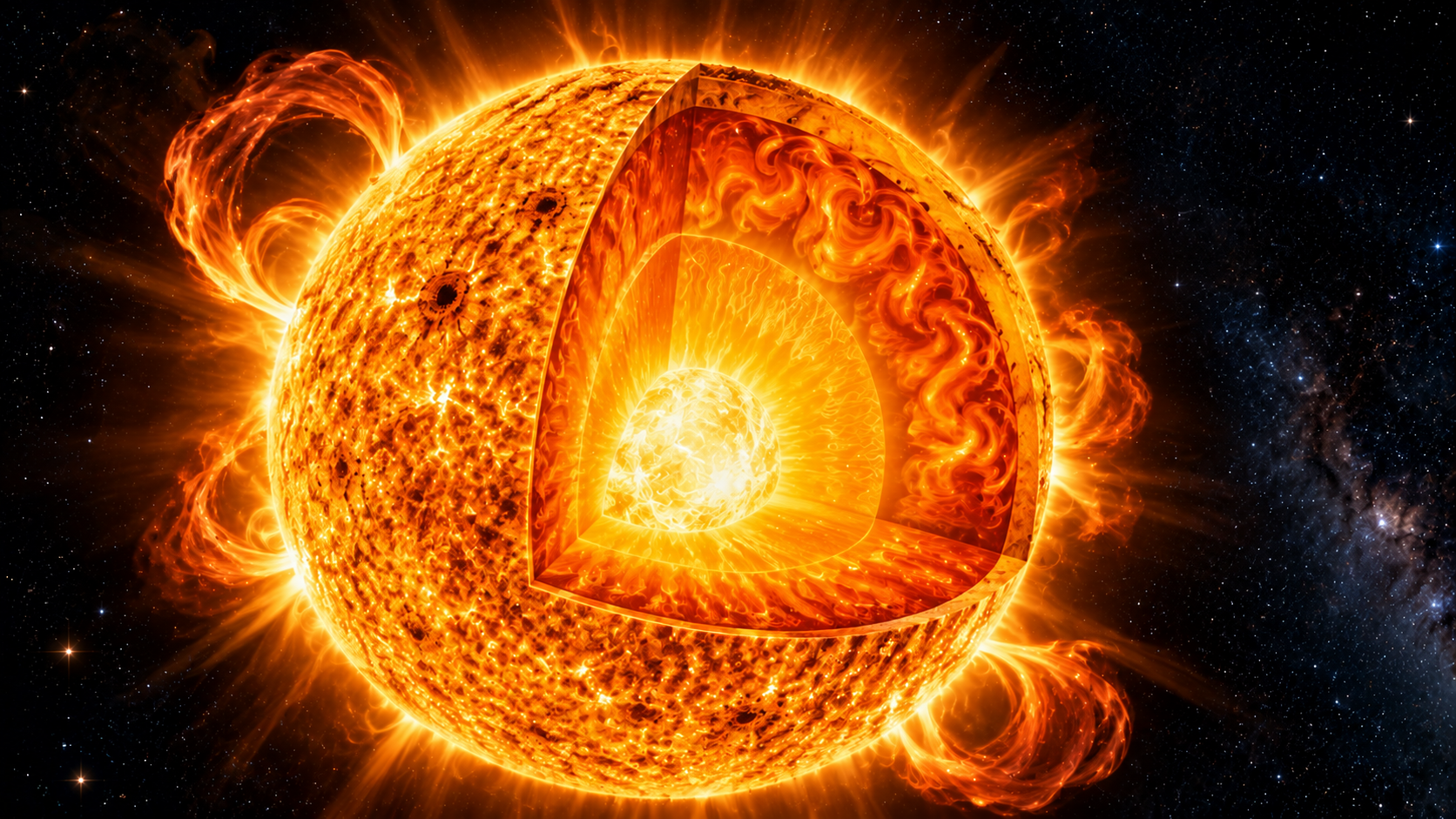
The Sun is a star too
During the day, the Sun looks completely different from the stars we see at night. It appears as a huge glowing ball in the sky, while the stars look like tiny dots.
The main reason for this difference is distance.
The Sun is about 150 million kilometers from Earth, which is close enough for its light and heat to have a major effect on our planet. The other stars are vastly farther away. Even the nearest star beyond our Sun is more than four light-years away, so its light has to travel an enormous distance before reaching us.
If you could somehow move the Sun much farther away, it would eventually look like a star in the night sky. And if you could bring another star close enough to Earth, it could look much larger and brighter.
The stars haven't suddenly become tiny. They only appear tiny because they are so far away.
What is happening inside a star?
A star begins as a huge cloud of gas in space. Gravity pulls the gas together, making the center of the cloud become denser and hotter.
Eventually, the temperature and pressure in the center become so extreme that hydrogen atoms can begin joining together. When this happens, some of their mass is converted into energy.
That energy moves outward through the star and eventually escapes into space as light and other forms of energy.
You can think of a star as having a gigantic energy-making engine deep inside it, although there are no moving parts like the engine in a car. The energy comes from the behavior of matter under conditions that are far beyond anything we can create naturally on Earth.
This process of nuclear fusion is what makes stars shine. NASA explains that fusion in the cores of stars converts hydrogen into helium and releases the energy that keeps stars hot and glowing.
Why doesn't the star collapse?
There is another part of the story that makes stars especially interesting.
A star is enormous, and gravity is constantly pulling all of its material inward. If gravity were the only force acting on the star, the star would continue collapsing toward its center.
But the energy produced by fusion heats the material inside the star and creates pressure pushing outward. During most of a star's life, the inward pull of gravity and the outward pressure produced by the hot interior are in balance.
This balance allows the star to remain stable for millions or billions of years.
The star isn't sitting there without anything happening. Inside it, an enormous amount of energy is being produced and transported outward all the time.
Why are some stars brighter than others?
Look at the night sky and you'll notice that some stars appear brighter than others. That doesn't necessarily mean they are actually producing less light.
Distance makes a huge difference.
Imagine standing next to a flashlight. It can look very bright. Move hundreds of meters away and the same flashlight becomes much harder to see, even though it hasn't changed.
Stars work in a similar way. A very bright star that is extremely far away can appear faint, while a less powerful star that is much closer can look brighter.
Stars also differ in their actual size, temperature, and amount of energy they produce. Some are much more massive and energetic than our Sun, while others are smaller and cooler.
Why are some stars red and others blue?
Stars don't all have the same temperature, and their color gives us a clue about how hot they are.
The hottest stars can appear blue or blue-white. Stars with lower surface temperatures can appear yellow, orange, or red.
Our Sun looks yellow or white from Earth, although its surface temperature is actually much hotter than anything we normally experience.
This is similar to the way heated objects change color as their temperature changes. A piece of metal that is heated enough can begin to glow red, and as it becomes even hotter, its glow can move toward orange, yellow, and eventually brighter colors.
Astronomers can use the color of a star as one clue to estimate its temperature.
Are stars burning like a fire?
Not in the way a campfire burns.
When wood burns, it reacts chemically with oxygen and releases energy. A star doesn't need oxygen for its main energy source. Its energy comes from nuclear fusion, which happens deep inside its incredibly hot and dense core.
That difference is important because ordinary burning cannot produce nearly enough energy to power something as enormous as a star for billions of years.
A star is closer to a gigantic natural nuclear reactor than to a giant ball of fire.
The word "burning" is sometimes used when talking about stars because it makes the idea easier to picture, but the actual process is very different.
Stars don't shine forever
A star has a limited supply of material that can take part in fusion.
Our Sun is about 4.6 billion years old and is currently in the long, stable part of its life. It still has billions of years ahead of it before major changes begin.
What happens later depends largely on how massive a star is. Smaller stars can use their fuel very slowly and may shine for an extraordinarily long time. Very massive stars use their fuel much faster and can live for only millions of years before reaching the later stages of their lives.
Eventually, every star changes.
Some stars expand into enormous red giants and later leave behind a small, hot remnant called a white dwarf. Much more massive stars can end their lives in enormous explosions called supernovae, leaving behind extremely dense objects such as neutron stars or black holes.
So when you look at a star, you're not necessarily looking at something permanent. You're seeing one stage in a very long life.
The light from a star is a message from the past
There is something even stranger about starlight.
Light travels extremely fast, but space is so enormous that it can still take years, centuries, or much longer to reach us.
When you look at a star that is 100 light-years away, the light entering your eyes began its journey about 100 years ago. You are seeing that star as it looked when the light left it, not exactly as it looks today.
The farther away the star is, the farther back in time we are seeing.
This means that looking into space is also a way of looking into the past. Astronomers use this ancient light to learn how stars are born, how they change, what they are made of, and how the universe has changed over enormous periods of time.
We are connected to stars in another way too
Stars are not only interesting because they light up the night sky. They are also part of the story of the material that makes up our world.
Inside stars, nuclear fusion can create elements that are heavier than hydrogen, including carbon and oxygen. When some massive stars explode at the end of their lives, they can scatter elements into space.
Over enormous stretches of time, that material can become part of new stars, planets, and other objects.
So the atoms that make up rocks, oceans, plants, animals, and people have a much longer history than we might imagine. Some of the elements in our bodies were created in stars that existed long before Earth was formed.
That is one reason scientists sometimes describe us as being made of star stuff.
Questions your child might ask next
Why Does the Sun Shine? The Sun is a star, so it shines for the same reason other stars do. Nuclear fusion in its center releases enormous amounts of energy.
Why Are Some Stars Different Colors? Stars have different surface temperatures. Hotter stars tend to look blue or white, while cooler stars can look orange or red.
How Do We Know What Is Happening in Space? Astronomers study the light and other signals that reach Earth from distant objects. Those signals contain information about what stars and galaxies are made of and how they are changing.
Why Do Planets Go Around the Sun? The Sun's gravity pulls on the planets while their motion carries them forward, creating their orbits.
Explore it together
Go outside on a clear night and find the brightest stars you can see. Choose one and imagine how far away it might be.
Then ask your child something that sounds simple but has a surprising answer: When did the light we are seeing leave that star?
You can explain that a light-year is a measure of distance, not time. It is the distance light travels in one year. So a star 10 light-years away is sending us light that has been traveling for about 10 years.
Suddenly, the night sky becomes a kind of window into the past.
How Sapienta can help
A question about why stars shine can lead to questions about the Sun, planets, light, space travel, the history of the universe, and even where the elements in our own bodies came from.
Sapienta helps parents follow those connections. It considers what a child has already explored, along with their age and interests, and helps find another idea that builds naturally from what they already know.
You don't need to plan the whole journey yourself. Start with the star your child is looking at tonight, and let the next question lead somewhere new.
Raise curious, knowledgeable kids.